
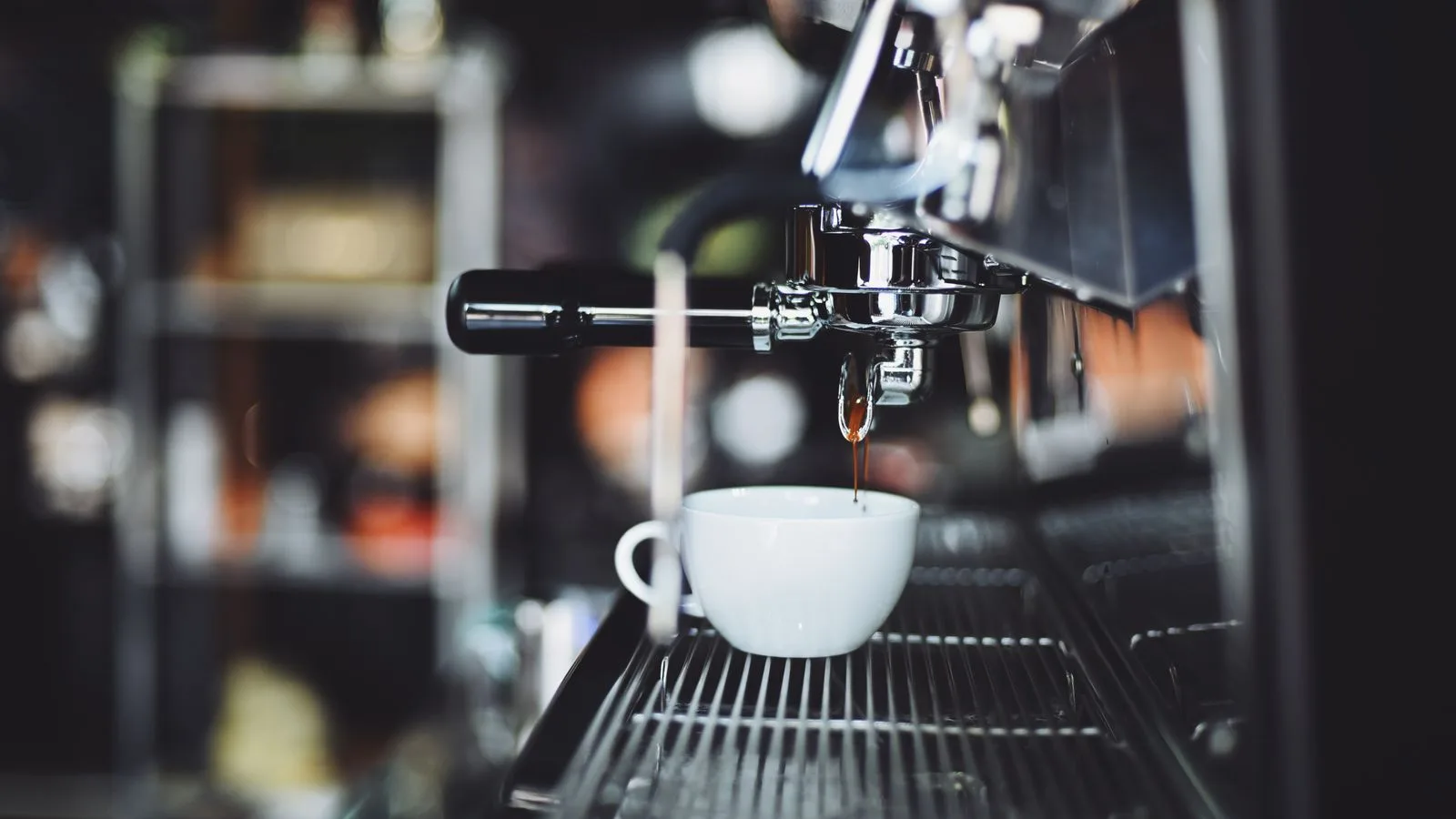
Espresso is a way to brew coffee
Pressure is the key part of espresso. A moka pot and a strong AeroPress recipe can both make a short, strong cup, but they skip the pump-espresso process. The word espresso names both the brewing method and the small drink it makes.
No machine yet? The guide to making espresso without a machine compares what each stovetop and hand-powered option actually makes.
The National Coffee Association’s espresso guide describes hot water forced through finely ground coffee under pressure in roughly 20 to 30 seconds. That's a handy beginner definition. Its numbers are a starting point, and the recipe and filter basket can vary by machine and café.
The word shot can hide big recipe differences. Write down the coffee amount, drink amount, time, temperature, and pressure. Then two people can compare what they actually made.
Quick answers
| Question | Espresso answer | Boundary to remember |
|---|---|---|
| Is it coffee? | Yes | Coffee is the ingredient and larger category |
| Is it a bean? | No | Any coffee can be brewed as espresso |
| Is it a roast? | No | “Espresso roast” is a roaster recommendation |
| Does it require pressure? | Yes | Concentrated coffee without the method is not espresso |
| Is one shot a fixed size? | No | Traditional and modern recipes differ |
| Does it always contain more caffeine? | Per ounce, usually | A larger drip serving can contain more total caffeine |
| Is crema required for good taste? | No | Crema is the tan foam on espresso; it does not prove good taste |
Those answers settle the category questions, but you still need a recipe. Two baristas can both make espresso with different coffee and drink amounts. To compare shots fairly, start with what went into the basket and how much came out.
Record five details for each shot
Espresso recipes get much easier to follow when you write down five details. Dose is the dry coffee in the basket. Yield is the weight of espresso in the cup. Time is how long brewing takes, counted from a start point you name.
Temperature describes the brew water or machine setting. Pressure describes how the machine pushes water through the packed coffee bed, called the puck. Keep those five together like a recipe card.
The Specialty Coffee Association’s discussion of the changing espresso definition repeats a traditional definition: 7 to 9 grams for a single, 25 to 35 milliliters in the cup, water near 195 to 205°F, 9 to 10 atmospheres, and 20 to 30 seconds. The article also explains that specialty coffee has moved past one narrow recipe. Many homes now use a double basket and measure the drink by weight.
That history gives you context. A traditional specification doesn't make a modern 18-gram recipe wrong, so write down the recipe you actually use. “18 grams in, 36 grams out” tells you more than “one double shot.”
Compare coffee in with espresso out
A brew ratio compares the dry coffee dose with the drink yield. An 18-gram dose that makes 36 grams of espresso is a 1:2 ratio, which the NCA uses as a practical espresso starting point. Think of it like rice to water: a recipe detail someone else can repeat, with taste still deciding whether you keep it.
Volume is harder to read because crema takes up space. Fresh coffee may build a tall foam layer, so the same drink weight can look bigger, and cup marks differ too. Weighing the yield keeps trapped gas from counting as liquid. It also makes ristretto and lungo easier to understand: ristretto usually makes less drink from a similar dose, and lungo makes more.
A ratio can't tell you whether the brew is any good. A 1:2 shot can be sour, bitter, hollow, balanced, or uneven. Taste it, watch the flow, and see whether it repeats with that coffee.
Fine grind slows the water down
You spread and tamp (press down) fine coffee into a puck, and the puck slows the water the pump pushes through it. Water can still find easier paths through it, and grind size, particle spread, dose, basket fill, tamp level, and coffee age all affect those paths.
If the grind is too coarse, water may rush through and the drink may taste thin or sharp. If it's too fine, flow may slow or stop. Time alone can't tell you how the drink tastes, and an uneven puck can have fast and slow spots at once. So “use fine coffee” is only the first line of an espresso recipe.
That's why the grinder matters. It needs steps small enough to change the flow without jumping past the right setting. Pre-ground coffee can work in a pressurized basket made to create its own resistance, while a normal non-pressurized basket shows grind freshness and grind changes much more directly.
More pressure isn't always better
Espresso machines often advertise pump pressure in bar (a unit of pressure), and that number may be much higher than the pressure at the puck. The heritage SCA definition describes roughly 9 to 10 atmospheres during brewing, and modern machines may start below that or change pressure during the shot.
When you shop, ask whether the machine can deliver steady, suitable pressure for your recipe, a better question than “Which machine has the biggest bar number?” A 15-bar pump doesn't mean the puck should get 15 bar, and it doesn't make that machine better than one with a lower published maximum.
Pressure can't fix the wrong grind or a cracked puck either. The machine supplies water and force, and the coffee bed supplies resistance. Espresso needs both, so count a grinder and puck prep in your setup.
Crema is foam, and taste is the judge
Crema is the tan-to-brown foam that often sits on fresh espresso. Pressure mixes in oils and releases trapped carbon dioxide, making bubbles that carry aroma. Freshness, roast, species, dose, basket, and recipe can all change its color, amount, and how long it lasts.
Some traditions care a lot about how it looks. The Istituto Espresso Italiano describes certified Italian espresso with fine hazel-to-dark-brown foam and a defined taste profile. That's the target for one tradition.
A thick layer of crema can sit on a bitter or uneven shot. A light roast can make less foam and still taste clean and sweet, and some blends with robusta make lots of crema. So read crema as a hint about gas, coffee, and prep, then taste the liquid.
Espresso uses ordinary coffee beans
No separate espresso plant exists. The bag can hold arabica, robusta, another coffee species, a blend, or a single origin, in a light, medium, or dark roast. An espresso label means the roaster recommends that coffee for this strong brewing method. It doesn't certify the species or the roast level.
Darker coffees that dissolve more easily can be friendlier for a new setup, especially with a grinder that has big steps. Lighter coffees may reward a better grinder, a higher temperature, a longer ratio, or more careful water. Those are tendencies of the process. A fresh medium roast with no espresso label may be easier and tastier than a stale bag with one.
Choose a bag that tells you something: roast date, origin or blend, roast description, and a starting recipe. Grind just before brewing when you can. Espresso makes a coffee's character easier to taste, and it also makes age and uneven grinding easier to notice.
Espresso tastes stronger because it is concentrated
Espresso packs the dissolved coffee and tiny suspended particles from a dose into a small drink. That gives it strong flavor, dense body, and a feel unlike a full mug of drip coffee. “Stronger” is accurate when it means concentration or how intense it tastes.
Total caffeine depends on serving size. The NCA cites a typical 1-ounce espresso at about 63 milligrams of caffeine and brewed coffee at roughly 12 to 16 milligrams per ounce. Espresso has more per ounce, but a full 8-ounce mug adds up to more total caffeine than that 1-ounce espresso. A café double, a one-shot cappuccino, and a large brewed coffee are all different servings, so compare their actual recipes.
Milk and water change strength without removing caffeine. An Americano made from two shots still carries the caffeine from both shots after you add water, and milk softens a latte's flavor while its espresso caffeine stays put.
Espresso is the base of many drinks
Once you have a shot, you can add water, milk, foam, or chocolate, or change the yield. An Americano adds hot water. An espresso macchiato adds a small mark of milk or foam. A cappuccino combines espresso with steamed milk and more airy foam.
A latte uses more liquid milk and thinner microfoam (milk foam with tiny bubbles). A flat white is usually smaller and tastes more of coffee than a latte. Ristretto and lungo change the espresso yield itself.
Each name tells you the intended drink, and cafés fill in their own recipe. The Starbucks espresso guide shows how one large chain uses espresso, ristretto, macchiato, cappuccino, latte, and flat white. Another café may use different cup sizes or shot counts.
For brewed coffee with an added shot, read the red eye coffee guide. For a milk-and-foam choice, compare cortado and cappuccino. Both explain what to confirm when you order.
When you order, ask about the things that change the drink. How many shots, and what cup size? Is the macchiato traditional or a sweet chain recipe, and does the flat white use ristretto? Clear questions get you the drink you meant.
What equipment makes espresso
A setup built from separate parts needs a machine, a grinder that can make espresso-fine coffee, a suitable basket and portafilter (the handled holder for the basket), a scale, suitable water, and cleaning supplies. The machine can be manual, lever-driven, semi-automatic, automatic, or superautomatic, as long as it creates the pressure espresso needs. You can leave out the grinder only when you deliberately use pre-ground coffee with a compatible basket.
Heater count, portafilter diameter, PID (a system that keeps temperature steadier), a gauge, or the level of automation won't change what espresso is. Those features change control, speed, repeatability, milk steps, cleaning, and cost. Find my setup treats them as limits that narrow your choices across several specifications.
Already have a machine? Start with its exact manual. Confirm the intended basket, dose range, cleaning cycle, and water guidance before you reach for a generic internet recipe. A standard gives you shared words, and your appliance manual sets the safety and care rules.
Start with a first recipe
For a conventional double basket that supports it, begin with the maker's dose guidance. Then try a 1:2 drink ratio and a fine grind that reaches that yield somewhere in the broad 20 to 30-second range. Weigh the dose and yield, and taste the shot.
Change one thing at a time, and stop adjusting once the shot tastes good to you and repeats. Coffees won't all finish at the same second, so treat the window as a starting test.
If the shot tastes sharp and runs quickly, a finer grind may help. If it tastes harsh and runs very slowly, a coarser grind or a shorter yield may help. Taste and flow can disagree, and a damaged puck can send mixed signals. Use the dial-in guide or Fix a shot to keep the next change controlled.
Continue from the definition into repeatable first-week steps.
Make a measured first espresso →Common questions
Is espresso just strong coffee?
No. Strength describes concentration or taste; espresso names a pressure-driven brewing method. Other methods can make concentrated coffee without making espresso.
Is espresso a bean or roast?
No. Any coffee can be brewed as espresso. An espresso label is the roaster's recommendation for that brewing method.
Does espresso always have crema?
Crema is the tan foam often found on espresso. Fresh coffee and pressure usually create it, but its volume and persistence vary. Its presence alone does not prove that a shot tastes good.
How much coffee is in one espresso?
There is no single worldwide recipe. Traditional definitions often describe a smaller single shot, while many modern cafés use a filter basket that holds more dry coffee for a double drink.

About Mara Ellis
Mara Ellis is Espresso Receipt’s fictional editorial voice. Warm, practical, and lightly witty, she turns coffee jargon into clear choices for your counter, budget, and next shot.
Read the profile and guides by Mara Ellis →Sources (4)
- Espresso brewing guideNational Coffee Association · Check date not recorded(opens in a new tab)
- Defining the Ever-Changing EspressoSpecialty Coffee Association · Check date not recorded(opens in a new tab)
- Certified Italian Espresso and CappuccinoIstituto Espresso Italiano · Check date not recorded(opens in a new tab)
- Espresso explainedStarbucks · Check date not recorded(opens in a new tab)
See an old price or conflicting detail? Send a correction.
How we researched this
We did not test, own, taste, or measure any espresso against these definitions, so a recipe here stays an estimate until someone pulls it and writes it down under stated conditions. The facts here come from the published trade, certification, and maker sources below.
What the evidence labels mean
- Source checked
- A cited source stated this fact when Espresso Receipt checked it. This is not a physical product test.
- Estimated
- This is calculated from stated inputs and assumptions. It is not a measured result or a current quote.
- Observed physical test
- This is a hands-on result for the exact unit under a stated test method.
- We could not confirm this
- The available sources do not establish one reliable answer.