
This guide has no physical testing, ownership, taste-test results, or measured pressure, dose, or yield values.
What counts as espresso
Espresso is a brewing method first and a small drink second. The National Coffee Association describes high pressure forcing nearly boiling water through finely ground coffee in about 20 to 30 seconds. It gives 1 gram of dry coffee to 2 grams of espresso (1:2) as the quick ratio.
The Specialty Coffee Association reprints the older SCAA definition: a 25 to 35 ml drink from 7 to 9 grams of coffee (14 to 18 grams for a double), water at 195 to 205°F, 9 to 10 atmospheres of pressure, and a 20 to 30 second brew. The same article reports that surveyed baristas averaged 8.5 bar, with 9 bar the most common answer. The Istituto Espresso Italiano describes its certified espresso as a cup of about 25 milliliters.
Pressure units trip people up, so here is the conversion. NIST lists one standard atmosphere as 101,325 pascals and one bar as 100,000 pascals, so one atmosphere is 1.01325 bar. That makes 9 to 10 atmospheres about 9.1 to 10.1 bar.
So is espresso just finely ground coffee? No. Fine coffee is one ingredient. The pressure and the short brew are what make it espresso. For the full definition, read what espresso actually is.
Method comparison table
This table puts each no-machine option next to the espresso definition. Every figure comes from the maker or a standards source named in its row. Ratios marked "stated" come from the source; the rest are our own arithmetic from those figures. Where a source gives water going in rather than drink coming out, the column says so, because some water stays behind in the grounds.
| Method and source | Pressure the source states | Coffee dose | Water in or drink out | Ratio we calculated | Reaches the espresso pressure description? |
|---|---|---|---|---|---|
| Espresso reference (SCA, NCA) | 9 to 10 atmospheres, about 9.1 to 10.1 bar | 7 to 9 g single, 14 to 18 g double | 25 to 35 ml drink per single | 1:2 by weight, stated by NCA | Reference |
| Moka pot (Bialetti Moka Express manual) | Says the pot develops pressure inside; no number | Fill the funnel without pressing; no gram figure in the text | Water up to the lower edge of the safety valve | Not possible from the manual text | Unknown; no figure stated |
| AeroPress standard recipe | "Gentle constant pressure"; no number | 16 to 18 g | Water to the 4 mark | Not possible; the page gives no volume for the mark | Unknown; no figure stated |
| AeroPress espresso-style recipe | No number | 19 g | 60 g hot water in | About 1:3.2 water in (60 ÷ 19) | Unknown; no figure stated |
| Wacaco Nanopresso hand pump | Up to 18 bar maximum | 8 g basket (16 g with the Barista Kit) | 80 ml water tank; Barista Kit double listed up to 120 ml of espresso | At most 10 ml water per gram (80 ÷ 8); kit double up to 7.5 ml drink per gram (120 ÷ 16) | Stated maximum is above the range |
| Flair 58 manual lever press | 6 to 9 bar target (the brew steps say 6 to 10) | 18 to 20 g | Not stated; stop at your chosen shot weight | 36 to 40 g drink if you use NCA's 1:2 | Brew steps' 6 to 10 bar overlaps the range; the 6 to 9 bar chart target stops just under it |
| French press (NCA) | Steeps, then a plunger filter; no brewing pressure stated | Coarse grind; dose set by the ratio | 10 to 16 g water per gram of coffee | 1:10 to 1:16, stated by NCA | No |
| Instant coffee or espresso powder | None at home; already brewed and dried | Not a brewing dose | Dissolves in water | Not applicable | No |
Two things jump out. Only the lever press and the hand pump publish a pressure figure in espresso territory. And even NCA's strongest French press ratio, 1 gram of coffee to 10 grams of water, is far more dilute than a 1:2 espresso. If you want to try your own numbers, the espresso ratio calculator turns any dose and yield into a ratio.
A maker's stated pressure is not a reading from your cup. The Nanopresso figure is a maximum, and the Flair figure is a target you hit by adjusting grind and dose.
Moka pot: strong stovetop coffee
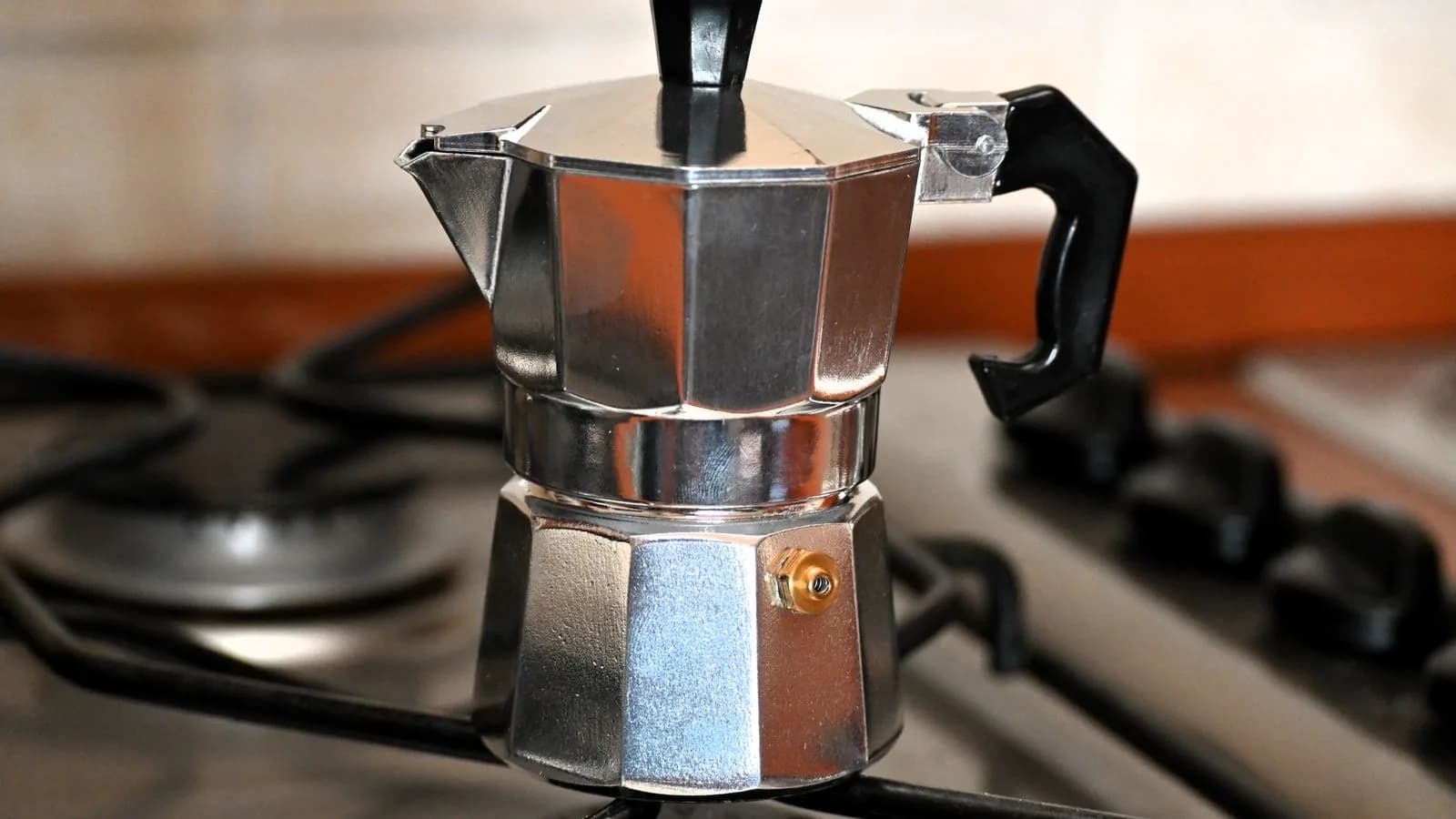
A moka pot is the classic answer to "What can I use if I don't have an espresso machine?" It sits on the stove, builds pressure in the bottom chamber, and sends brewed coffee into the top chamber. The result is strong and short. It does not publish espresso-level pressure, and its maker does not ask for espresso grounds.
Bialetti's Moka Express instructions boil down to this:
- Fill the bottom chamber with cold water up to the lower edge of the safety valve.
- Insert the funnel and fill it with coffee ground for moka. Do not press it down, and keep powder off the rim.
- Screw the top on firmly without forcing the handle.
- Heat it. Keep a gas flame from reaching past the pot's edge, and skip the highest setting on an electric or ceramic hob.
- Take it off the heat when the top chamber is full, then stir the coffee before pouring.
The same manual says never to use a fine grind and never to press coffee into the funnel. It also warns that the pot develops pressure inside and can burn you or burst if you ignore the instructions. If the safety valve vents, check the grind, check that the coffee is not packed, and check that you did not overfill the water.
AeroPress: a simple espresso-style shot
If you would rather skip a stovetop pot, the AeroPress is a sensible place to start. You only need hot water from a kettle. It is a hand-pressed brewer, and its maker calls its short recipe "espresso-style," not espresso.
AeroPress's standard instructions use water at 185°F (85°C), or boiling water if your kettle has no temperature setting. Add 16 to 18 grams of medium-fine coffee, fill to the 4 mark, stir for about 3 seconds, wait 30 seconds, then press gently. The store-bought medium-grind version waits 60 seconds instead.
The espresso-style recipe from AeroPress uses less water and aims for espresso strength:
- Fit the stainless steel filter into the Flow Control filter cap. The recipe page sells the stainless filter as a separate item, so check whether your AeroPress already includes both parts.
- Add 19 grams of coffee ground on the coarse side of espresso.
- Pour in 60 grams of hot water and stir for 15 seconds.
- Insert the plunger and press through.
The recipe note says pressing all the way through pushes more oils and fines into the cup. Stop at the hiss if you want a little less texture. It can work as the coffee in a homemade milk drink. It is still an espresso-style concentrate, not a shot that meets the pressure description.
Hand-pump brewers: pressure you make with your hands
A hand-pump brewer builds pressure as you pump it by hand. Wacaco lists the Nanopresso at up to 18 bar (261 PSI), with an 8 gram basket, an 80 ml water tank, and an extra-fine grind recommendation. An add-on Barista Kit allows a 16 gram double up to 120 ml.
Two details matter before you buy one. The standard head is pressurized, which Wacaco says helps with less precise grinding and can be disconnected. And the page describes tamping two ways: "slightly tamped" in one place and "tamped hard" in another. Start with the instructions in the box. Wacaco also says reaching 18 bar takes about 13 kg (28.66 lbs) of force on the knob. You still need hot water from a kettle.
Manual lever presses: the closest match
A manual lever press is the most direct way to make espresso without a pump machine. You push the water through with a long lever and read the result on a gauge.
The Flair 58 manual calls for 18 to 20 grams of fresh beans ground on a burr grinder. You tamp, lower the lever slowly, and aim for 30 to 35 seconds between 6 and 9 bar on its gauge chart. The written brew steps say 6 to 10 bar. The chart tells you to grind finer when a shot runs fast at low pressure, and coarser when it runs long or high. Above 12 bar, the chart says to stop and discard the grounds.
One honest footnote: the Flair 58 has an electric preheat system for its brew cylinder, according to the same manual. Your arm supplies the pressure, not a pump. Plan for real arm effort and a grinder that can go espresso-fine.
French press: stronger coffee, not espresso
"How do you make espresso with regular coffee?" You can make it stronger, but brewing strength alone will not turn it into espresso. The NCA's French press guide uses a coarse grind, 1 gram of coffee to 10 to 16 grams of water, and about 4 minutes of steeping before you press the filter down. That plunger separates the grounds. It does not force water through a packed bed of fine coffee.
A cafetière is the same brewer by another name. Use the 1:10 end of the range when you want something bolder under milk. Expect a larger, less concentrated drink than espresso, so a latte made with it will be more diluted.
Instant coffee and espresso powder
The NCA explains instant coffee as coffee brewed into a strong concentrate and then dried, either freeze-dried or spray-dried. You add hot water and it dissolves. No brewing happens in your kitchen.
Espresso powder is a close cousin sold for baking. King Arthur describes its espresso powder as ground, brewed, and dried coffee that dissolves readily, with a teaspoon or two suggested for chocolate recipes. It is the right call for brownies and chocolate cake. It is not a substitute for a pulled shot in a cup.
The grinder is the real limit
Every method here needs a grind it can use. The NCA says espresso needs a fine grind and recommends a burr grinder, because a blade grinder cannot promise consistent particles. The moka pot manual says never go fine. The Nanopresso asks for extra-fine. The Flair 58 manual asks for a burr grinder.
A blade grinder or a pre-ground bag makes the Flair 58 a poor fit, and pushes a Nanopresso onto its pressurized head, which Wacaco says helps with less precise grinding. Pre-ground coffee sold for moka pots suits a moka pot, and store-bought medium grind suits a standard AeroPress. Bialetti says not to use drip-filter grind in its pot. Use the espresso grind size chart to match a grind to how fast the coffee flows.
You do not need special beans for any of these methods. The NCA says espresso is not a type of coffee bean or even a roast. Pick a coffee you enjoy, and read espresso beans versus coffee beans if an "espresso roast" label is making the choice harder than it needs to be.
When to stop substituting and buy a machine
A substitute is a great deal if you drink a few milk coffees a week and like the ritual. It gets less appealing if you want a pump shot every morning, or if you are already shopping for a grinder that can go espresso-fine.
If the cafe bill is the reason you are asking, run your numbers in the espresso break-even calculator first. When you are ready to compare real setups, find a machine that fits your drinks and counter. The beginner machine guide explains the whole first setup, and our first week with a pump machine covers what happens after it arrives.
How we researched this
We compared manufacturer instructions from Bialetti, AeroPress, Wacaco, and Flair with the espresso descriptions published by the NCA, the SCA, and the Istituto Espresso Italiano. NIST supplied the pressure conversion. Sources were checked on September 16, 2026. Calculated ratios are simple arithmetic from those published numbers.
A few numbers are missing on purpose. The Bialetti manual's text gives no pressure figure or gram dose. The AeroPress page gives no milliliter volume for its fill marks. Flair gives no target drink weight. Where a source did not state a figure, the table says so instead of guessing.
Continue the specific decision described in this article.
Find a machine that fits your drinks and counterCommon questions
How do you make espresso with regular coffee?
You can brew regular coffee stronger, but not into espresso without real pressure. Even NCA's strongest French press ratio, 1 gram of coffee to 10 grams of water, is far more dilute than a 1:2 espresso.
What's the easiest way to make espresso at home?
A simple no-machine option is the AeroPress espresso-style recipe: 19 grams of coffee, 60 grams of hot water, a 15-second stir, then press. It needs the AeroPress stainless steel filter and Flow Control filter cap. AeroPress calls it espresso-style, not espresso.
What can I use if I don't have an espresso machine?
A moka pot or AeroPress makes short, strong coffee. For pressure in the espresso range, a hand-pump brewer or a manual lever press is the closer match, according to their makers.
Is espresso just finely ground coffee?
No. Espresso is a method. Hot water is forced through fine coffee under pressure for about 20 to 30 seconds. Fine grounds alone do not make a drink espresso.
How we researched this
- Page length
- 2,088 words
- Reading time
- 10 minutes
- Sources used
- 12
- Products mentioned
- 0
- Article published
We use published product details, dated price checks, and labeled estimates to help you decide. We label a hands-on result as an observed test only when we name the exact product and test it. A checked price is not a current quote or your final delivered total.
What the evidence labels mean
- Source checked
- A cited source stated this fact when Espresso Receipt checked it. This is not a physical product test.
- Estimated
- This is calculated from stated inputs and assumptions. It is not a measured result or a current quote.
- Observed physical test
- This is a hands-on result for the exact unit under a stated test method.
- We could not confirm this
- The available sources do not establish one reliable answer.

About Mara Ellis
Mara Ellis is Espresso Receipt’s fictional editorial voice. Warm, practical, and lightly witty, she turns coffee jargon into clear choices for your counter, budget, and next shot.
Read the profile and guides by Mara Ellis →Sources used
We use manufacturer, standards group, government, and authorized-retailer records when available. Open a source to read the original details.
- Espresso brewing guideNational Coffee Association · Espresso Receipt checked this source on 2026-09-16(opens in a new tab)
- Defining the Ever-Changing EspressoSpecialty Coffee Association · Espresso Receipt checked this source on 2026-09-16(opens in a new tab)
- Certified Italian EspressoIstituto Espresso Italiano · Espresso Receipt checked this source on 2026-09-16(opens in a new tab)
- Guide to the SI, Appendix B.8 conversion factorsNIST · Espresso Receipt checked this source on 2026-09-16(opens in a new tab)
- Moka Express instructionsBialetti · Espresso Receipt checked this source on 2026-09-16(opens in a new tab)
- How to use the AeroPressAeroPress · Espresso Receipt checked this source on 2026-09-16(opens in a new tab)
- An espresso style shot with AeroPressAeroPress · Espresso Receipt checked this source on 2026-09-16(opens in a new tab)
- NanopressoWacaco · Espresso Receipt checked this source on 2026-09-16(opens in a new tab)
- Flair 58 instruction manualFlair Espresso · Espresso Receipt checked this source on 2026-09-16(opens in a new tab)
- French press coffeeNational Coffee Association · Espresso Receipt checked this source on 2026-09-16(opens in a new tab)
- Instant coffeeNational Coffee Association · Espresso Receipt checked this source on 2026-09-16(opens in a new tab)
- Espresso powderKing Arthur Baking · Espresso Receipt checked this source on 2026-09-16(opens in a new tab)
See an old price or conflicting detail? Send a correction.