
THE DECISION
Which one fits your routine?
Encore ESP
You want a straightforward hopper and numbered settings.
Main limit: Stepped settings do not provide continuous adjustment.
DF54
You prefer weighing each dose and a stepless dial.
Main limit: Loading and transfer add active steps.
DF64 II
The 64mm platform serves a specific plan.
Main limit: Higher price is not a proven taste improvement.
Sette 270
You want timed hopper dosing and a fine-adjustment ring.
Main limit: Timed operation does not measure the grounds in your basket.
Choose one daily routine
Choose the routine you want to repeat each morning. A hopper holds beans for several doses. Single dosing means you weigh and load beans for each drink. Stepped adjustment clicks between settings; a stepless dial moves continuously.
| Start with | Choose it when | Checked base price | Main limit |
|---|---|---|---|
| Encore ESP | You want a hopper and numbered settings | $199.95 | Fixed clicks limit positions between settings |
| DF54 | You weigh each dose and want a stepless dial | $229.00 | Loading and transferring add steps |
| DF64 II | You have a reason to choose the 64mm burr platform | $399.00 | The larger burr does not establish better taste |
| Sette 270 | You want timed hopper dosing and fine adjustment | $399.95 | The timer does not weigh the grounds |
These U.S. source prices were checked October 3, 2026. They are not Amazon prices. The full grinder catalog covers other options; this is a focused shortlist with no physical taste comparison.
Start with Encore ESP or DF54
Choose the Baratza Encore ESP when you want hopper adjustment and its included dosing cup. This is the Encore ESP, model ZCG495. The Encore and Encore ESP Pro are different models, so check the full name.
The Encore ESP manual lists 40 settings, with settings 1 to 20 for espresso. It says to adjust while the grinder is running or completely empty of beans. Follow that model-specific instruction; use another grinder's own manual for its controls.
Choose MiiCoffee's DF54 if you prefer weighing each portion and recording a stepless setting. MiiCoffee identifies the current version as v1.5, with 54mm stainless-steel flat burrs. Its Black and White 110v U.S.-plug variants were available at $229 when checked. Availability can change before you order.
The DF54 package lists a dosing cup, rubber adapter, bellows, lid, cleaning brush, and manual. MiiCoffee recommends using the cup, especially with a portafilter other than 58mm. A cup size alone does not establish fit with your handled basket holder.
At these checked prices, the DF54 costs $29.05 more than the Encore ESP: $229.00 minus $199.95. Choose that extra work when changing coffees matters to you. We have no matched test showing that the price difference improves taste.
Spend more for a named feature
Choose the MiiCoffee DF64 II when its 64mm burr platform serves a specific plan. The maker identifies the current version as V2.6, with stock stainless-steel flat burrs and stepless adjustment. Its Black and White 110v U.S.-plug variants were available at $399 when checked. Optional burr upgrades cost extra.
The standard package lists a metal dosing cup, rubber adapter, bellows, lid, cleaning brush, and manual. It costs $170 more than the DF54 at the checked base prices. Read the DF54 versus DF64 II comparison if that is your remaining choice. Burr diameter alone cannot settle taste, noise, or retained grounds.
Choose the Baratza Sette 270 for timed hopper dosing. Baratza listed model ZCG1270 at $399.95 with an Add to cart action when checked. Its broad adjustment settings and stepless fine-adjustment ring give you two controls to learn.
A timer stops grinding after a set duration. You still need to weigh the output when the coffee or setting changes. The Sette 270Wi is a different model; do not treat a 270 listing as weight-based dosing.
Keep the checkout below $500
Count the grinder, tax, delivery, and any missing scale or transfer accessories. The remaining budget before those costs is $500 minus the checked base price:
| Grinder | Checked base price | Remaining from $500 |
|---|---|---|
| Encore ESP | $199.95 | $300.05 |
| DF54 | $229.00 | $271.00 |
| DF64 II | $399.00 | $101.00 |
| Sette 270 | $399.95 | $100.05 |
For a hypothetical DF64 II order, assume 8% tax on the $399 grinder and $0 delivery. Tax is $31.92, so the total is $430.92. That leaves $69.08 for missing items. Your tax rules, address, delivery charge, and chosen options can change the total.
MiiCoffee advertises free shipping on orders over $69, but check delivery eligibility at checkout. Baratza's delivery total is unknown for your address. Neither source price is a complete machine-and-grinder budget. Use the setup calculator with your actual costs and mark equipment you already own as on hand.
Check the room to use it
Measure the room to load beans and remove the cup or hopper. Keep space for your scale and portafilter. The DF54 and DF64 II have conflicting dimension evidence in our catalog. We do not rank them by counter size.
Confirm the exact revision, U.S. electrical version, cup-transfer path, return terms, and service contact. A product photograph cannot prove working clearance. If you often switch regular and decaf, the single-dose guide explains that routine. Single dosing does not guarantee that all old grounds leave the grinder.
Try your current grinder first
Keep your usual coffee dose and drink weight fixed. Follow your grinder's manual and make one small grind change. Pull the next shot and taste it. Stop adjusting when the cup suits you; stop the test if the appliance jams or behaves abnormally, and follow its manual.
If the control cannot make a useful change, or loading and transfer remain awkward, write down that limitation. Take it back to the shortlist. You now have a specific reason to choose a grinder. The dial-in guide helps you keep the comparison controlled.
Add tax, delivery, and missing equipment to the checked grinder price.
Check the whole equipment budgetProducts mentioned
Open a product to see its exact source, checked date, known uncertainty, dimensions, and main downside.
Compare these 4 grinders side by side →
Common questions
What is a good first espresso grinder?
Start with Encore ESP for a hopper and numbered settings, or DF54 for stepless single dosing. Choose the routine you will repeat.
Is a DF64 II worth more than a DF54?
It can be useful when you specifically need the 64mm platform. The checked price difference is $170, and the higher price doesn't prove better taste.
Does timed dosing replace weighing?
No. A timer controls how long the grinder runs, so it can't tell you the final mass in the basket. Check the output when the coffee or grind changes.

About Mara Ellis
Warm, practical, and lightly witty, Mara turns coffee jargon into clear choices for your counter, budget, and next shot.
Read the profile and guides by Mara Ellis →Sources (7)
- Encore ESPBaratza · Checked October 3, 2026(opens in a new tab)
- DF54 single-dose grinderMiiCoffee · Checked October 3, 2026(opens in a new tab)
- DF64 II single-dose grinderMiiCoffee · Checked October 3, 2026(opens in a new tab)
- Sette 270Baratza · Checked October 3, 2026(opens in a new tab)
- Encore ESP operations manualBaratza · Checked October 3, 2026(opens in a new tab)
- Encore ESP product pageBaratza · Checked October 20, 2026(opens in a new tab)
- Sette 270 product pageBaratza · Checked October 20, 2026(opens in a new tab)
See an old price or conflicting detail? Send a correction.
How we researched this
- Method
- Primary product pages, U.S. variants, and Encore ESP manual checked October 3, 2026. Existing catalog conflicts are retained.
- What we added
- Four-routine comparison, current variant labels, budget remainders, and a hypothetical tax calculation.
- Limits
- Desk research only. No physical testing, ownership, taste comparison, or measured product or drink performance. Demand estimates are planning numbers, and they do not predict traffic. Stock and checkout prices can change.
We checked the four primary product pages and the Encore ESP manual on October 3, 2026. We also checked MiiCoffee's variant records for the stated U.S.-plug choices. The tables compare source-listed controls, dated prices, and our budget arithmetic.
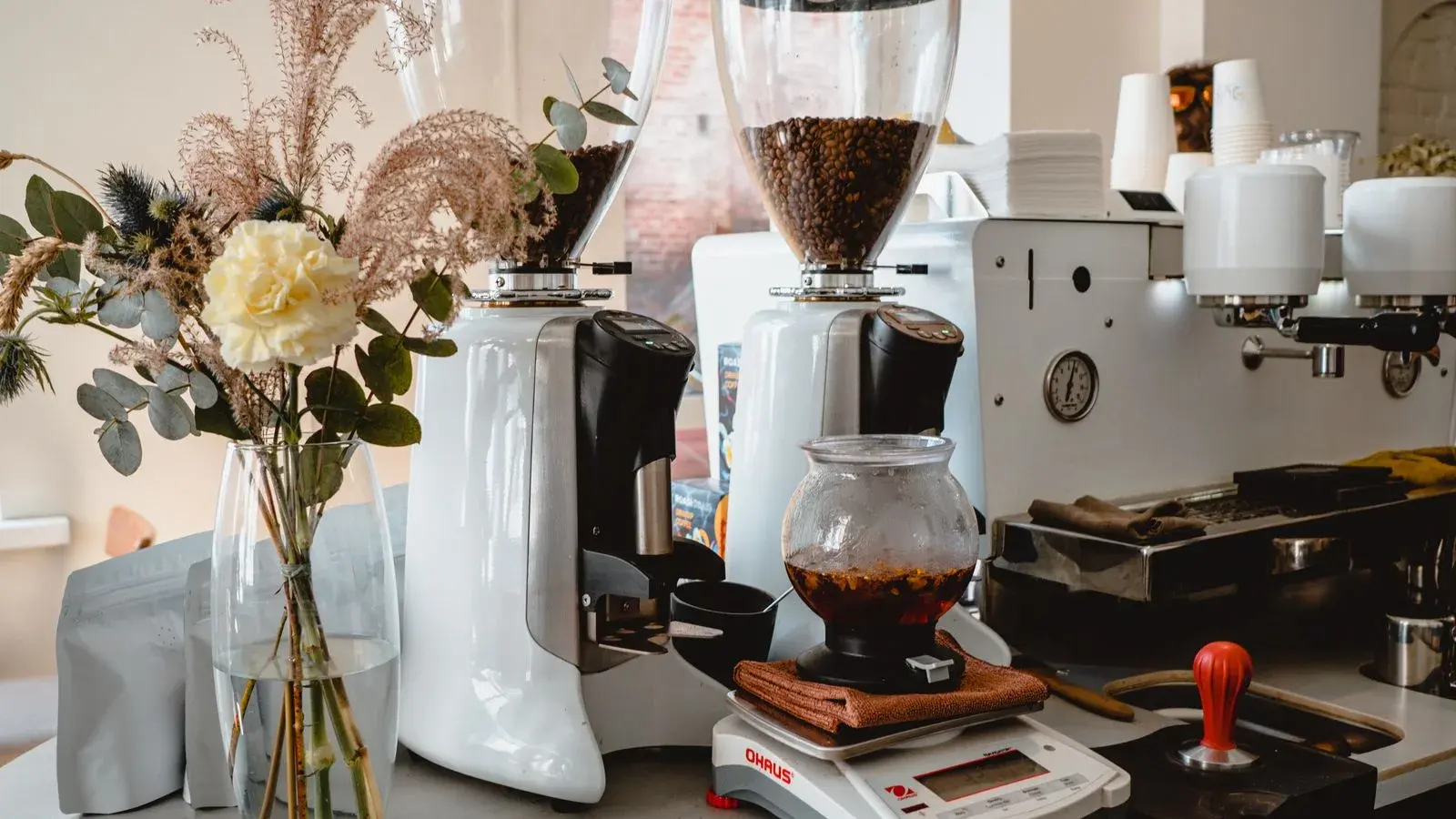
We did not test, own, taste, or measure these grinders or their performance. Retained-ground, noise, durability, and taste comparisons remain unknown. The café photograph shows general equipment and does not identify any of the four recommended models.
What the evidence labels mean
- Source checked
- A cited source stated this fact when Espresso Receipt checked it. This is not a physical product test.
- Estimated
- This is calculated from stated inputs and assumptions. It is not a measured result or a current quote.
- Observed physical test
- This is a hands-on result for the exact unit under a stated test method.
- We could not confirm this
- The available sources do not establish one reliable answer.