
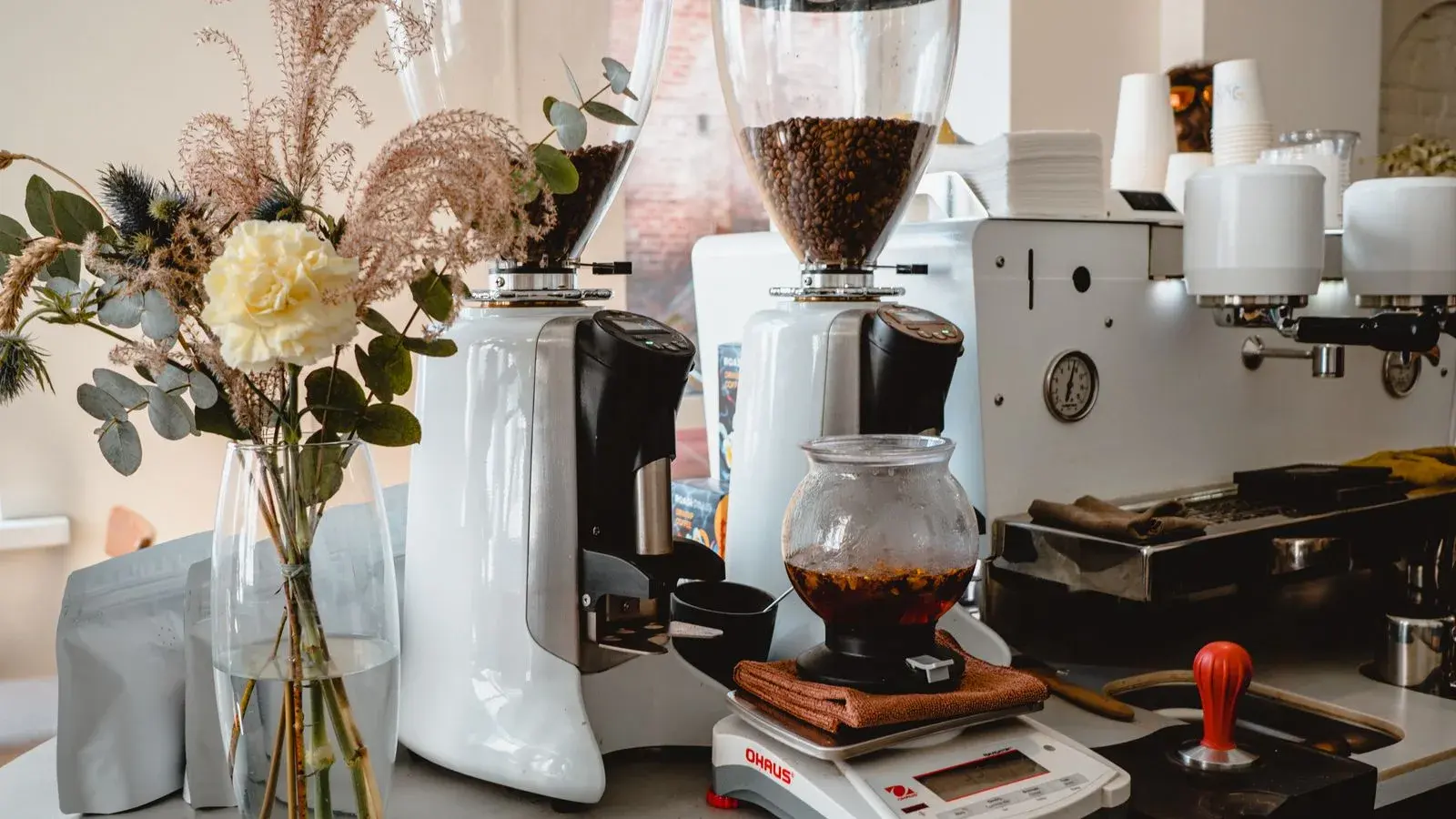
A grind-by-weight espresso grinder weighs the grounds as it runs and stops at your target dose. It can remove a repeated weighing-and-topping-up step if you keep beans in the hopper. You still choose the grind size, prepare the basket and weigh the finished espresso.
Choose the stopping routine
Choose the routine that fits how you handle your coffee. Dose means the mass of dry coffee you put in the basket. Grind-by-weight controls that amount; it does not choose your recipe.
| Routine | What stops the grinder | What you do |
|---|---|---|
| Grind by weight | A target mass of grounds | Set the dose and check the result while learning the machine |
| Timed dosing | A programmed grinding time | Weigh the output and adjust the timer when needed |
| Single dosing | The stop method on your exact grinder | Weigh one portion of beans, grind it and check the grounds |
Baratza's Sette 270Wi is a weight-based example. Breville's Smart Grinder Pro BCG820 uses a programmable timer. Those controls answer different tasks. Neither description establishes a taste winner.
If you change coffee frequently and prefer an empty hopper, start with the single-dose grinder guide. A scale inside a grinder does not establish that it suits single dosing.
Check the exact model and hopper rules
Match the full model name to its manual. Sette 270Wi, Sette 270W and Sette 270 are separate versions. Eureka also separates its Mignon Libra for espresso from the Libra Brew, whose recommended use is filter brewing.
Baratza's 270Wi v2.4 manual, page 7 recommends keeping two or more doses in the hopper for automatic weight dosing. It says the software uses the flow rate and previous grind errors to adjust stopping. Adding only one dose does not provide accurate, consistent automatic dosing under that manual's instructions.
The same manual separates the saved weight from the grind-size setting. Changing a preset dose does not make the grounds finer. Confirm the instructions supplied with your exact unit if its controls differ.
Keep the cup scale
Use a separate scale to measure the espresso in your cup. A grinder's target covers the dry coffee. Your finished drink is a different measurement.
For a hypothetical basket recipe that permits 18 g of dry coffee, a 1:2 brew ratio gives a 36 g drink target: 18 × 2 = 36. The ratio calculator converts those two quantities. Your basket instructions and taste determine whether that recipe suits you.
The grinder's displayed decimal places also do not establish verified dosing accuracy. We have no independent measurements for the models discussed here. Keep published resolution, a manufacturer's accuracy claim and your own check as separate information.
Check your current routine first
Observe your existing setup before replacing it. This is an unperformed reader exercise. Use the same coffee, grind setting and permitted dose for three normal preparations, and keep the finished drink weight fixed.
Keep hands clear of moving burrs, the grinding surfaces. Do not hold or push a container while a built-in scale measures it. Stop with your exact model's control if grounds back up or the container becomes unstable.
- Set a separate scale to zero with an empty receiving container on it. Remove the container for grinding.
- Grind using your exact manual's normal method. After grinding stops, weigh the grounds on that separate scale before you correct the dose. Record this uncorrected mass.
- If needed, correct the dose using your normal safe method. Weigh it again and record the final mass and correction work. Brew only after reaching your chosen permitted dose.
- Repeat for three normal preparations. Follow the grinder's required rest intervals and keep the finished drink weight fixed. Compare the correction work, then taste the drinks.
For example, hypothetical outputs of 17.6 g, 18.1 g and 17.8 g span 0.5 g: 18.1 − 17.6 = 0.5. That is a calculation, not a measured grinder result or an acceptance limit. Decide whether correcting your actual doses is a task you want to automate. Three preparations cannot establish long-term accuracy or reliability.
For the 270Wi, the manual requires a level supported portafilter, the handle that holds the basket. Page 7 identifies STOP as the control to end and reset a cycle. Follow your own model's stop control if grounds back up or the container becomes unstable.
Stop and unplug before adjusting supports, assembling parts or cleaning. Let the appliance cool as its manual requires. Do not put hands or tools near moving burrs, the grinding surfaces. Contact the manufacturer if normal dosing remains unreliable. This exercise does not include calibration, repair or disassembly.
Count the whole setup
Compare the delivered grinder price with the cost of keeping your current grinder and scale. Include tax, delivery, any required compatible cup or funnel, and service access. Keep the scale you need for the cup in both totals.
Check the exact portafilter, basket and funnel combination with the seller or manufacturer. A diameter alone does not confirm that a handle sits level on the weighing support. Measure the room needed to fill the hopper and remove the receiving container, too.
Choose weight-based stopping when you keep beans in the hopper and want that repeated dose correction handled automatically. Keep your current routine if its checks are easy and the coffee already suits you. Use the grinder catalog to check exact models after choosing the routine. Confirm each model's stopping method; the catalog includes both timed and weight-based grinders.
The catalog includes timed and weight-based grinders. Confirm the stopping method for the exact model.
Check exact grinder models
About Mara Ellis
Warm, practical, and lightly witty, Mara turns coffee jargon into clear choices for your counter, budget, and next shot.
Read the profile and guides by Mara Ellis →Sources (6)
- Sette 270Wi ZCG1279 US product pageBaratza · Checked October 18, 2026(opens in a new tab)
- Sette 270Wi v2.4 August 2019 manualBaratza · Checked October 18, 2026(opens in a new tab)
- Smart Grinder Pro BCG820 US product pageBreville · Checked October 18, 2026(opens in a new tab)
- BCG820 I23 USCM manualBreville · Checked October 18, 2026(opens in a new tab)
- Mignon Libra espresso specificationEureka · Checked October 18, 2026(opens in a new tab)
- Mignon Libra Brew specificationEureka · Checked October 18, 2026(opens in a new tab)
See an old price or conflicting detail? Send a correction.
How we researched this
We compared current manufacturer pages and the Sette 270Wi v2.4 and Smart Grinder Pro I23 manuals. The table separates stopping methods. The three-preparation exercise and numerical examples are unperformed suggestions and hypothetical calculations.
We have no physical testing, ownership, taste tests or performance measurement for this comparison. Exact accessory fit, delivered prices, dosing accuracy and long-term reliability remain unverified. The photograph shows grinders on a café counter; it does not identify the models discussed.
What the evidence labels mean
- Source checked
- A cited source stated this fact when Espresso Receipt checked it. This is not a physical product test.
- Estimated
- This is calculated from stated inputs and assumptions. It is not a measured result or a current quote.
- Observed physical test
- This is a hands-on result for the exact unit under a stated test method.
- We could not confirm this
- The available sources do not establish one reliable answer.