
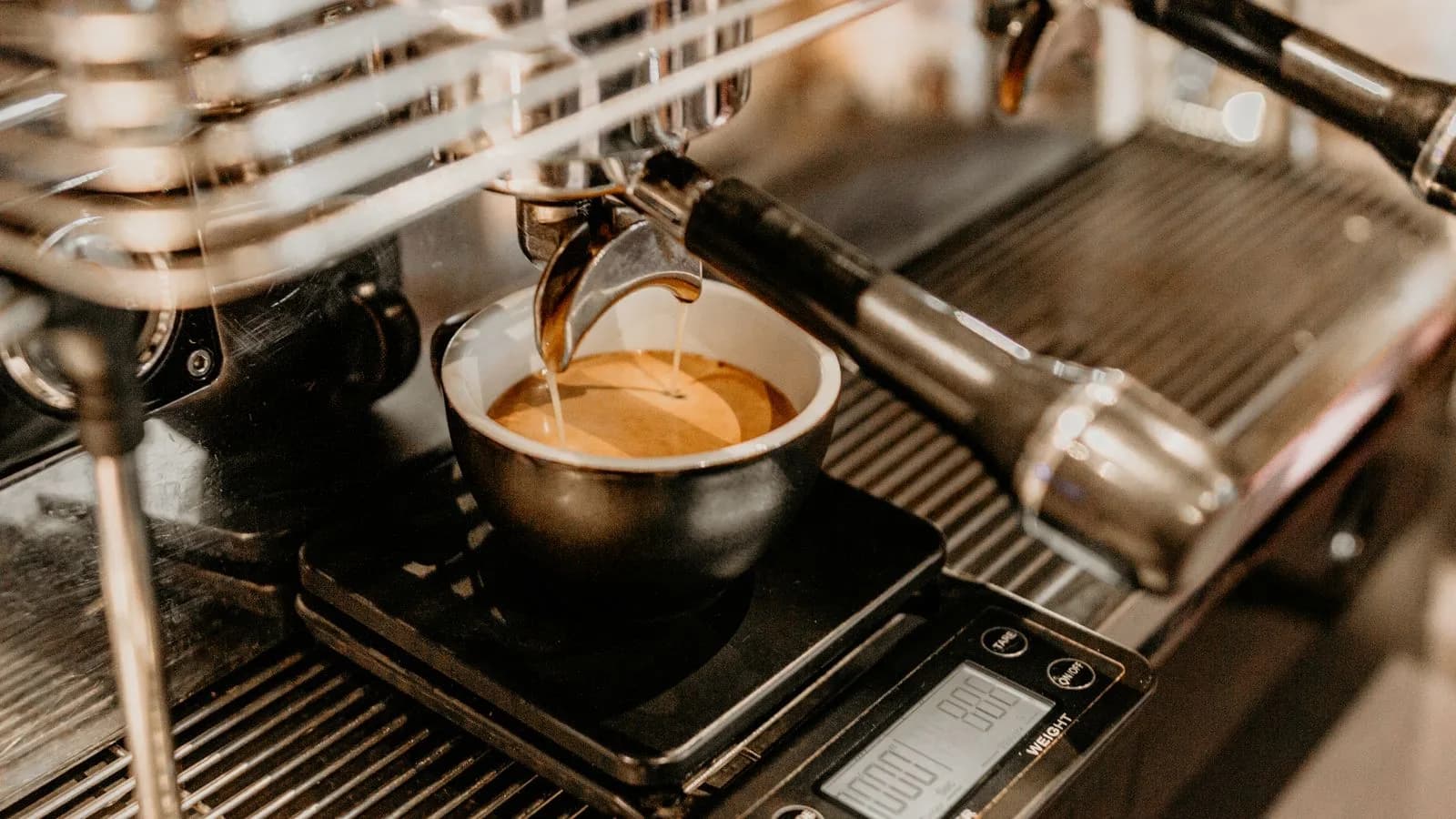
THE DECISION
Which one fits your routine?
Smallest footprint: Bookoo Themis Mini
Your drip tray is small and you want 0.1 g readability on an 80 × 80 mm platform.
Main limit: Listed at $129.00 on September 17, 2026, with a 1000 g capacity, the lowest of the five.
Lowest listed price: Timemore Basic 3.0
You have room for 140 × 120 mm and want a first-drop timer for $59.00 (listed September 17, 2026).
Main limit: Lists 0.1 g accuracy only under 500 g, an IPX3 rating, and a restocking notice with orders expected to ship by the end of January.
Highest water rating: Bookoo Themis Ultra
Your scale sits in drips and splashes and you want an IP67 rating.
Main limit: At 127 × 112 × 18 mm it is larger and taller than the Themis Mini, and Bookoo's $99.00 price on September 17, 2026, applies to the black scale-only option.
What readability does an espresso scale need?
Get a scale that reads in 0.1 g steps. Readability is the smallest change the display can show. NIST Handbook 44 calls it the value of the scale division and, for a digital scale, defines it as "the difference between two consecutively indicated or printed values."
Breville's dial-in guide calls 18 to 22 g "a safe start" and 1:2 the standard ratio, so take 18 g in and 36 g out. A display that rounds to its nearest step can hide up to half a step either way. Stop lag is the extra coffee that lands after you see your target and stop the shot, whether from a slow display or a slow hand.
| Scale situation | Dose could really be | Drink could really be | Ratio range | Off from 1:2 by up to |
|---|---|---|---|---|
| 0.1 g steps, no lag | 17.95 to 18.05 g | 35.95 to 36.05 g | 1:1.99 to 1:2.01 | 0.4% |
| 1 g steps, no lag | 17.5 to 18.5 g | 35.5 to 36.5 g | 1:1.92 to 1:2.09 | 4.3% |
| 0.1 g steps, 0.1 second lag | 17.95 to 18.05 g | 36.07 to 36.19 g | 1:2.00 to 1:2.02 | 0.8% |
| 0.1 g steps, 0.5 second lag | 17.95 to 18.05 g | 36.55 to 36.77 g | 1:2.02 to 1:2.05 | 2.4% |
| 0.1 g steps, 1 second lag | 17.95 to 18.05 g | 37.15 to 37.49 g | 1:2.06 to 1:2.09 | 4.4% |
| 1 g steps, 1 second lag | 17.5 to 18.5 g | 36.7 to 37.94 g | 1:1.98 to 1:2.17 | 8.4% |
The lag rows add an average flow of 1.2 to 1.44 g per second to the rounding. That's 36 g spread over Breville's 25 to 30 second shot window (36 ÷ 30 = 1.2, and 36 ÷ 25 = 1.44). Real shots speed up and slow down, so treat these rows as arithmetic from one recipe. The 0.1 second row matches the response time Bookoo lists for one scale below; the 0.5 and 1 second rows are round examples.
A 1 g scale can move your ratio about as much as a full second of late stopping. And both errors stack, so a slow 1 g scale can drift more than 8% from the recipe you wrote down. That's enough to send you back to the grinder for a change the scale caused.
Which espresso scale should you buy?
Choose a 0.1 g scale that fits your drip tray, then pick by timer style, water rating, and price. Here's what five makers list on their own product pages, checked September 17, 2026.
| Scale | Readability or accuracy the maker lists | Capacity | Timer | Size (W × L × H) | Water rating | Power | Maker's listed price |
|---|---|---|---|---|---|---|---|
| Acaia Lunar | 0.1 g / 0.01 g readability | 2000 g | Espresso modes start and stop a timer or tare automatically | 105 × 105 × 15 mm | No IP rating listed; warranty covers water damage | Rechargeable, USB-C, 30 to 40 hours | $250.00 |
| Bookoo Themis Mini | 0.1 g readability | 1000 g | Flow rate, Timer, and Auto modes listed | 80 × 80 × 15 mm | IPX4 | Rechargeable, 500 mAh, 24 hours of use | $129.00 scale only ($138.00 with case) |
| Bookoo Themis Ultra | 0.1 g readability | 2000 g | Auto timer; Weight, Ratio, and Flow modes | 127 × 112 × 18 mm | IP67 | Rechargeable, USB-C, 72 hours | $99.00 black, scale only (marked down from $109.00) |
| Timemore Basic 3.0 | 0.1 g accuracy under 500 g; accuracy variances of 1 g to 1000 g and 3 g to 2000 g | 2000 g | Espresso mode auto-tares; timing begins with the first drop | 140 × 120 × 20 mm | IPX3 | Rechargeable, 1600 mAh, USB-C, up to 24 hours | $59.00 |
| Hario V60 Drip Scale | 0.1 g from 2 to 200 g, 0.5 g to 500 g, 1 g to 2000 g | 2000 g | Built-in timer; auto-start not stated | 120 × 190 × 29 mm | Not water resistant | Batteries included | $60.00 |
To tare is to reset the display to zero with the cup already on the scale, so it shows only the coffee. The IP code comes from the IEC 60529 standard, and a summary of that standard lists a second digit of 3 as spraying water, 4 as splashing water from all directions, and 7 as temporary immersion. An X in the first spot means dust protection has no rating there, and the 6 in IP67 means dust-tight.
Bookoo lists a response time under 100 ms for the Themis Ultra. The other pages we read don't list one. A checked price is not your final total, and sale prices change.
Now match a row to your counter:
- For a small drip tray, start with the smallest size in the table that still reads 0.1 g.
- For a tight budget with room on the tray, the Timemore Basic 3.0 lists 0.1 g accuracy under 500 g, a first-drop timer, and a $59.00 price. On September 17, 2026, its page also said Timemore is restocking and expects orders to ship by the end of January.
- For a splashy counter, compare water ratings first. Bookoo lists IP67 for the Themis Ultra, and Hario says its V60 Drip Scale is not water resistant.
If you want one default from the listed specs, start with the Themis Mini. Of these five, it has the smallest footprint, shares the lowest height, and lists 0.1 g readability and an Auto mode for $129.00 (Bookoo, September 17, 2026). The Themis Ultra fits instead if your tray has room for 127 × 112 × 18 mm and you want Bookoo's IP67 rating and $99.00 price for the black scale-only option. Measure your tray first, then put your dose and target drink weight into the espresso ratio calculator so the number you stop the shot on is written down before you pull.
Are espresso scales worth it?
Yes, if you want to repeat a shot you liked. Breville's dial-in guide says that to calculate your ratio, "you'll need a scale to weigh the actual input (dry grounds) as well as the output (brewed espresso)."
Machine buttons measure something else. The Breville Barista Express manual sets its 1 CUP button at approximately 1 oz / 30 ml and its 2 CUP button at approximately 2 oz / 60 ml. Those are volumes. Our espresso shot ounces guide explains why grams give you a more repeatable recipe than fluid ounces.
Count the scale into the whole setup. On September 17, 2026, Breville listed the Barista Pro at $849.95. The $59.00 Timemore works out to about 7% of that machine price (59 ÷ 849.95 = 0.069), and the $250.00 Lunar to about 29% (250 ÷ 849.95 = 0.294). Think of it like buying measuring cups for a new oven: small next to the oven, and you use them every time.
Your grinder has a scale question of its own. Grinders that weigh the dose as they grind are a separate purchase, and our espresso grinder guide is the place to start there.
Is a scale with a timer worth it?
Yes, because you read weight and time from one display while the shot runs. Check when the timer starts, because two timers can give the same shot two different times.
Breville's dial-in guide times a shot from "as soon as you activate your brewing cycle" and gives 25 to 30 seconds. The Timemore Basic 3.0 page says espresso mode timing begins "with the first drop." The Barista Pro booklet says espresso will start to flow after 8 to 12 seconds.
On a Barista Pro shot that lands in Breville's window, a first-drop timer would show about 13 to 22 seconds (25 minus 12, and 30 minus 8).
So write the timer style next to the time on your recipe. If you compare against a manual or a guide, use the same starting point it uses. When a shot runs far faster than your usual time and the puck comes out soupy, the wet espresso puck guide helps you decide whether that matters.
Will the scale fit under your portafilter?
It fits if the scale sits flat on your drip tray and the cup still clears the spouts on top of it. Measure two things first: the flat area of the drip tray grate, and the height from the grate to the bottom of the spouts.
Then do the counter math. Subtract the scale's height from that clearance, and the rest is the room for your cup. The five scales above run from 15 mm tall (Lunar and Themis Mini) to 29 mm tall (Hario V60 Drip Scale). Say your spouts sit 80 mm above the grate: a 15 mm scale leaves 65 mm for the cup, and a 29 mm scale leaves 51 mm.
Footprint matters just as much, so hold the size column in the table against your tray's flat area. Pick from the scales that sit fully on the grate with the display in view.
Coffee scale vs espresso scale
Any scale that reads 0.1 g across your whole load can weigh espresso. The difference is in the details a pour-over scale may not need: a small footprint, a low height, a timer that waits for the first drop, and some water rating for the drip tray.
The load is the part to check. The Hario V60 Drip Scale reads 0.1 g only from 2 to 200 g, then 0.5 g up to 500 g. If your cup plus 36 g of espresso weighs more than 200 g, the display switches to the bigger step. The Timemore Basic 3.0 keeps its listed 0.1 g variance up to 500 g.
Weigh your heaviest cup on the scale you already own. If it reads under 164 g (200 minus 36), your shot stays in the 0.1 g range on that Hario.
How to check your scale reads correctly
Check three things: zero, repeatability, and a known weight. NIST Handbook 44 describes zero-load balance as "a correct weight indication or representation of zero when there is no load" on the scale. So an empty scale should read zero, and it should come back to zero when you lift the cup off.
Try this with your cup: keep the same cup and the same spot on the platform, put it on and lift it off five times, and write down each reading. If the readings stay within one display step (0.1 g on these scales), you're done. Acaia lists 0.1 g repeatability for the Lunar, which gives you a sense of that range.
If the readings spread wider, or the empty scale won't settle at zero, calibrate with the manual's method. Acaia's 500 g calibration weight was listed at $36.00 on September 17, 2026, with a permissible error of ± 0.0075 g, and Acaia recommends calibrating when a scale is moved to a new location. Stop and contact the maker if a scale still won't return to zero after calibrating.
Once it reads true, write your dose, drink weight, time, and timer style on one line. Change one thing at a time, then let the shot diagnosis tool or the dial-in guide pick your next small turn.
Enter your dose and ratio to get the drink weight to stop the shot on.
Set your ratio before you pullCommon questions
Which coffee scale is best for espresso?
On listed specs, start with the Bookoo Themis Mini, which has the smallest footprint (80 × 80 mm) of the five scales we checked September 17, 2026. Bookoo lists 0.1 g readability and an Auto mode for $129.00. Measure your drip tray first, because the largest, the Hario V60 Drip Scale, is 120 × 190 mm.
Are espresso scales worth it?
Yes, if you want to repeat a shot you liked. Breville's dial-in guide says you need a scale to weigh both the dry grounds and the brewed espresso to calculate your ratio. On September 17, 2026, Timemore listed the Basic 3.0 at $59.00, about 7% of Breville's $849.95 listed Barista Pro price.
Is a shot of espresso 1 or 2 oz?
On a Breville Barista Express, a single is about 1 oz and a double about 2 oz. Its manual sets the 1 CUP button at approximately 1 oz / 30 ml and the 2 CUP button at approximately 2 oz / 60 ml. Other machines and recipes can differ, so weigh the drink in grams for a repeatable recipe.
What is the best weighing scale for espresso?
On listed specs, a 0.1 g scale such as the Bookoo Themis Mini suits espresso weighing, since Bookoo lists 0.1 g readability. On an 18 g in, 36 g out recipe, a 1 g display can hide a ratio from 1:1.92 to 1:2.09, and 0.1 g steps keep it between 1:1.99 and 1:2.01 before stop lag.
Do you need an espresso scale with a timer?
A timer helps because you read weight and time on one display during the shot. Check when it starts counting. Timemore says its Basic 3.0 espresso mode starts timing with the first drop, and Breville's dial-in guide counts 25 to 30 seconds from the start of brewing. Write the timer style next to each recipe.
What is the best espresso scale with a timer?
Start with a 0.1 g scale whose timer starts itself and that fits your tray. On September 17, 2026, Acaia listed espresso modes that start a timer on the $250.00 Lunar, Timemore listed first-drop timing on the $59.00 Basic 3.0, and Bookoo listed an Auto timer on the $99.00 black Themis Ultra.

About Mara Ellis
Mara Ellis is Espresso Receipt’s fictional editorial voice. Warm, practical, and lightly witty, she turns coffee jargon into clear choices for your counter, budget, and next shot.
Read the profile and guides by Mara Ellis →Sources (12)
- NIST Handbook 44 (2026), Appendix D: DefinitionsNational Institute of Standards and Technology · Checked 2026-09-17(opens in a new tab)
- How to dial in espresso: the beginner's guideBreville · Checked 2026-09-17(opens in a new tab)
- Lunar espresso scale product pageAcaia · Checked 2026-09-17(opens in a new tab)
- Themis Mini coffee scale product pageBOOKOO · Checked 2026-09-17(opens in a new tab)
- Themis Ultra coffee scale product pageBOOKOO · Checked 2026-09-17(opens in a new tab)
- Basic 3.0 electronic espresso scale with timer product pageTIMEMORE · Checked 2026-09-17(opens in a new tab)
- V60 Drip Scale product pageHario USA · Checked 2026-09-17(opens in a new tab)
- the Barista Express instruction book (BES870)Breville · Checked 2026-09-17(opens in a new tab)
- Barista Pro product page (BES878)Breville · Checked 2026-09-17(opens in a new tab)
- the Barista Pro instruction book (BES878, USCM)Breville · Checked 2026-09-17(opens in a new tab)
- IP Protection Ratings (IP Code): Table, Meaning & Applications (IEC 60529)Industry Electronics · Checked 2026-09-17(opens in a new tab)
- Calibration Weight 500 g product pageAcaia · Checked 2026-09-17(opens in a new tab)
See an old price or conflicting detail? Send a correction.
How we researched this
- Method
- Five scale makers' U.S. product pages, Acaia's calibration weight page, NIST Handbook 44 Appendix D (2026), an IEC 60529 IP code summary, Breville's dial-in guide, Barista Pro product page, and two U.S. Breville instruction books, fetched and checked September 17, 2026, with September 17 U.S. DataForSEO demand and result-page research.
- What we added
- A ratio table showing how 0.1 g versus 1 g readability and stop lag shift an 18 g in, 36 g out recipe, a five-scale spec table from maker pages, first-drop timer arithmetic, and drip tray clearance math.
- Limits
- Desk research only. No physical testing, ownership, taste comparison, or measured scale, shot, or timing values. Specs and prices are the makers' own listings on the check date. Lag rows use example values and an average flow. Demand estimates are planning numbers from DataForSEO; they do not predict traffic.
We read the product pages for the Acaia Lunar, Bookoo Themis Mini and Themis Ultra, Timemore Basic 3.0, and Hario V60 Drip Scale, plus Acaia's calibration weight page, NIST Handbook 44's definitions, a summary of the IEC 60529 IP code, Breville's dial-in guide, and two Breville manuals. We checked those sources on September 17, 2026. The ratio table, the timer offsets, and the price shares are simple arithmetic from those published numbers.
Some values are missing. Hario's V60 Drip Scale page doesn't say whether its timer starts on its own, and only Bookoo lists a response time. Timemore lists accuracy by load range, while the other makers list readability or scale steps.
We did not test, own, taste, or measure these scales or shots. The facts here come from the sources below and our stated math.
What the evidence labels mean
- Source checked
- A cited source stated this fact when Espresso Receipt checked it. This is not a physical product test.
- Estimated
- This is calculated from stated inputs and assumptions. It is not a measured result or a current quote.
- Observed physical test
- This is a hands-on result for the exact unit under a stated test method.
- We could not confirm this
- The available sources do not establish one reliable answer.