
START HERE
Check before you change anything
Before you start: The group head, portafilter, and water are hot. Never remove the portafilter while the machine is brewing. Unplug the machine and let it cool before cleaning, and do not open the case or take apart a valve yourself.
Wet puck, but the shot tastes good and flows in its usual time
Change nothing. Write down dose, yield, and time.
Stop if: Taste or flow time drifts over the next few shots; then diagnose the shot.
Soupy puck with a sour, weak, or fast shot
Grind one step finer, or raise the dose by 0.5 g, but not both.
Stop if: Flow starts later than your manual's over extraction line (Bambino Plus 12 seconds, Barista Pro 13 seconds, Barista Express 8 seconds) or only drips.
Tamped coffee sits well below the basket rim
Raise the dose by 0.5 g toward the basket's rated maximum.
Stop if: You reach the top of the basket's range, the coffee touches the shower screen, or the portafilter will not lock normally.
Firm pucks turned soupy with no recipe change
Check the exact manual's descaling schedule and follow it exactly.
Stop if: Brew flow is weak while steam works, the machine leaks, or the group keeps dripping. Contact the manufacturer or authorized service.
Is a wet puck a problem?
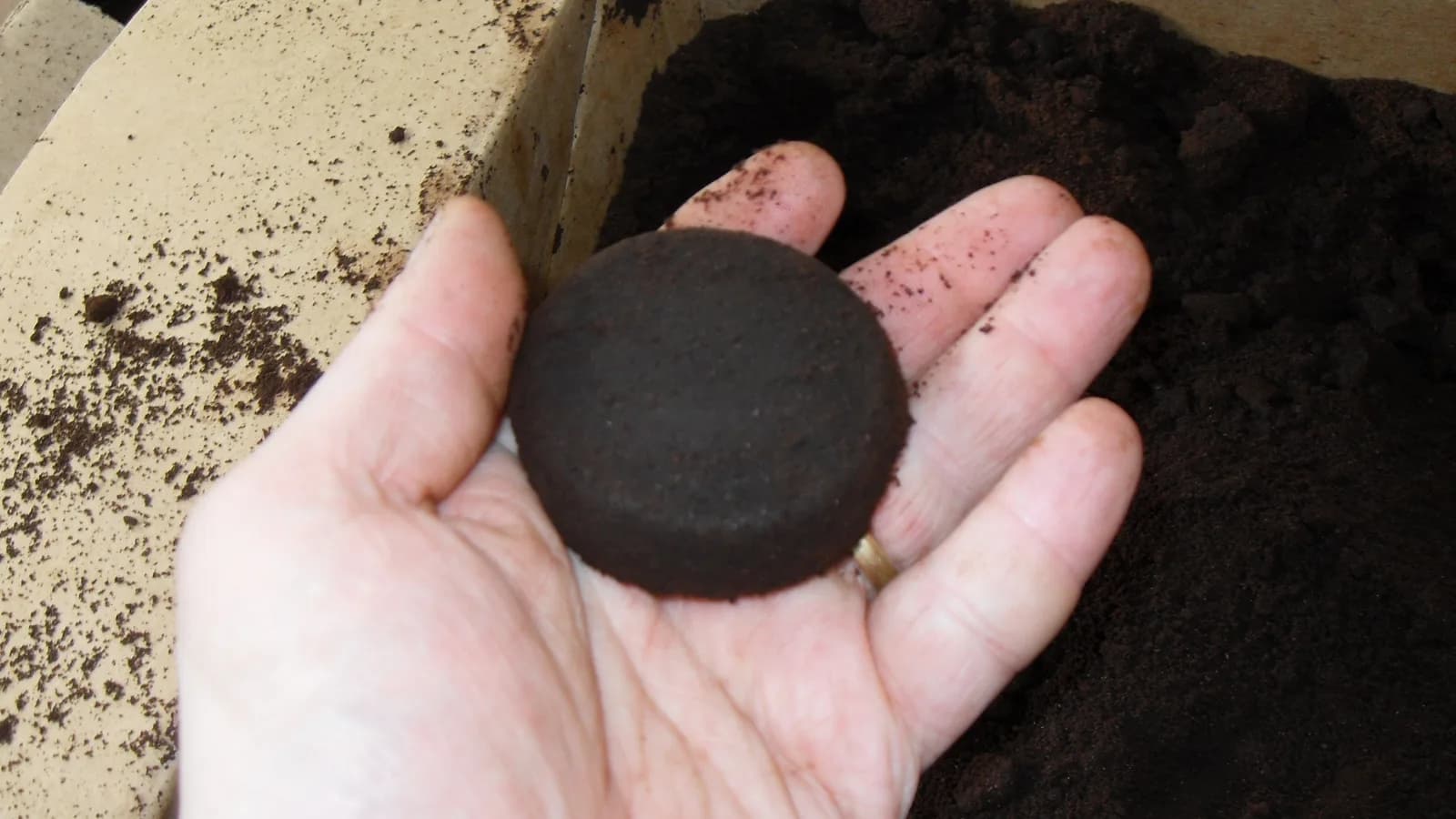
Taste the shot before you worry about the puck. The puck is the spent coffee left in the basket after brewing, and how wet it looks depends partly on the machine. What you drink comes out of the spout, so start there.
Here's how to read it:
- Shot tastes good and flows normally: keep the recipe. A soggy puck is a cleanup chore, and the cup is fine.
- Shot tastes sour, thin, or watery, or runs fast: the wet puck agrees with what you tasted. Make one change and pull again.
- Puck was firm for months and is suddenly soupy, with no recipe change: check the machine before you touch the grinder.
What counts as "flows normally"? Breville's Bambino Plus booklet describes a correct extraction (the water pulling the right amount of flavor from the coffee) as flow starting after 8 to 12 seconds, running "slow like warm honey." An under extracted shot starts flowing after 1 to 6 seconds, runs fast like water, and tastes "bitter/sharp, weak and watery."
Right beside those descriptions, the booklet says that if the puck is wet, refer to the Under Extraction section. The Barista Pro booklet gives the same advice, with flow starting after 1 to 7 seconds for its under extraction column.
A quick word on taste. Here, sour means that same sharp, thin, watery cup from Breville's under extraction words. Breville lists burnt bitterness under over extraction. If your shot tastes sharp and thin and ran fast, you're in the under extraction column.
Read those two lines together, like a recipe's ingredients and its method. Breville doesn't say a wet puck ruins a shot. It says a wet puck is your cue to check the shot.
So taste first. If the cup already looks and tastes right, you're done, and the soggy puck just goes in the knock box (the bin for spent pucks).
Why pucks come out wet
A wet puck usually comes down to a handful of causes. Some sit inside the machine, and others sit in your recipe.
Start with the valve. Some machines have a valve that releases pressure from the group head (where the portafilter, the handled basket holder, locks in) when the shot ends. Whole Latte Love's Rancilio Silvia listing says its 3-way solenoid "relieves pressure from the group after brewing." Breville lists a "Dry Puck Feature" on the Barista Pro and Barista Express that "removes excess water from the ground coffee in the filter basket after extraction for easy disposal of the coffee puck."
Whole Latte Love's Gaggia Classic Pro E24 listing spells out the link: it says machines at that price that leave "wet, messy pucks" differ from the E24, which "uses a solenoid valve to produce dry pucks." Without a feature like that, leftover water above the coffee has fewer places to go, so a damp puck can be the machine's normal result.
Then there's the room above the coffee. The gap between the tamped coffee and the shower screen (the metal screen the water comes through) is called headspace. A light dose leaves more room for water to sit on top of the puck when the shot ends.
The Barista Pro booklet suggests a level check: after tamping, the top edge of the tamper's metal cap should sit level with the top of the filter basket. Its under extraction fix is to increase the grind amount.
Grind matters too. A coarse grind lets water run through quickly, and Breville's booklets link a too coarse grind to under extraction. That's the same column the wet puck note points to.
Basket size can surprise you. A dose that suits one basket can be light in another, the way a cake batter looks thin in a bigger pan. The Barista Pro and Barista Express booklets say their 2 cup baskets are designed for about 16 to 19 g. The Specialty Coffee Association's espresso article reports that surveyed baristas most often used 18 g baskets, with an average dose of 18 to 20 g.
Timing plays a part. Wait until the flow has stopped completely before you pull the portafilter. The Bambino Plus booklet warns never to remove the portafilter during brewing, because hot steam or hot coffee can scald you.
And the coffee itself can change things. Breville's booklets say flavor depends on the beans, roast, freshness, grind, dose, and tamp, and they recommend adjusting one factor at a time. A new bag can want a new grind or dose even when nothing else moved.
Does your machine have a 3-way valve?
Find your machine in the table below. We included the machines in our catalog where a manufacturer document or an authorized retailer listing says something about pressure release after the shot. Where the source is silent or unclear, the table says unknown.
| Machine | What the source says | Source type | What a wet puck likely means |
|---|---|---|---|
| Gaggia Classic Pro E24 | Lists a 3-way solenoid valve | Authorized retailer listing | A firm puck is the expected result. A sudden change is worth checking. |
| Rancilio Silvia | 3-way solenoid "relieves pressure from the group after brewing"; spec table says "Automatic" | Authorized retailer listing | Same as above. |
| Profitec Go | Retailer spec: Three-Way Valve, Yes. Profitec's own page does not list one | Authorized retailer listing | Likely has one. Confirm with Profitec if it matters. |
| Lelit Elizabeth | Retailer spec: Three-Way Valve, Yes | Authorized retailer listing | Likely has one. |
| ECM Classika PID | Retailer spec says "Manual"; ECM's page lists no 3-way valve | Retailer listing and manufacturer page | Unknown. Ask ECM what "Manual" means here. |
| Breville Barista Express | U.S. manual lists a Dry Puck Feature; valve type not stated | Manufacturer manual | Designed to remove excess water, so check the shot first. |
| Breville Barista Pro | U.S. booklet lists a Dry Puck Feature; valve type not stated | Manufacturer manual | Same as above. |
| Breville Bambino Plus | U.S. booklet lists no dry puck feature or valve; says a wet puck points to Under Extraction | Manufacturer manual | Unknown for the valve. Check taste and flow time. |
| Any other machine | Not checked here | None | Unknown. Look for "3-way valve" or "dry puck" in your exact manual. |
A retailer listing comes from a store, and the manufacturer may describe the machine differently. A listed feature is a description on a page, and we have not measured any of them ourselves. Versions change, so check the exact model number on your machine.
Try this on your next shot
Say you own a Barista Pro, you use the single wall (non-pressurized) 2 cup basket, and you dose 16 g. You pull 32 g of espresso, a 1:2 ratio (32 ÷ 16 = 2). The puck is soupy and the shot tastes thin.
Your dose already sits inside Breville's 16 to 19 g range for that basket, right at the bottom. That leaves 3 g of room (19 minus 16). Raise the dose in 0.5 g steps and keep the ratio the same, so only one thing moves:
| Step | Dose | Change from 16 g | Yield at 1:2 |
|---|---|---|---|
| Start | 16.0 g | none | 32 g |
| 1 | 16.5 g | +3.1% (0.5 ÷ 16) | 33 g |
| 2 | 17.0 g | +6.3% (1 ÷ 16) | 34 g |
| 3 | 17.5 g | +9.4% (1.5 ÷ 16) | 35 g |
| Top of range | 19.0 g | +18.8% (3 ÷ 16) | 38 g |
After each step, pull one shot and taste it. A bigger dose usually slows the flow, so watch the time as well as the puck. Stop adding coffee when the shot tastes right, when flow starts after 13 seconds (the Barista Pro booklet's over extraction line), or when you reach 19 g. A damp puck under a good shot is fine.
Using a different basket? Swap in its rated range and do the same arithmetic. The espresso ratio calculator will do the yield math for each dose.
Find your manual's stop line
Find the extraction chart in your manual. It shows the stop line for grinding finer or adding coffee, which people most often get wrong because every machine draws it in a different place. Here are the three Breville booklets we cite:
| Machine | Correct flow starts after | Under extraction flow starts after | Over extraction flow starts after |
|---|---|---|---|
| Breville Bambino Plus | 8 to 12 seconds | 1 to 6 seconds | 12 seconds |
| Breville Barista Pro | 8 to 12 seconds | 1 to 7 seconds | 13 seconds |
| Breville Barista Express | 4 to 7 seconds | 1 to 3 seconds | 8 seconds |
These numbers count the seconds until coffee starts to flow. A Barista Express shot that starts flowing at 9 seconds has already crossed its booklet's over extraction line, while the same timing is normal on a Bambino Plus. If your machine isn't listed, find the extraction guide in your own manual and use its numbers.
Two situations sit outside those checks. If water pools when you unlock the portafilter, wait until the flow has fully stopped before you remove it, and stop if water or steam still spurts out. If the shot tastes bad even though the puck looks fine, work on the taste and leave the puck alone.
For grind moves, the espresso grind size chart explains what finer and coarser do to flow. Our dial-in guide explains why a dose that presses the puck against the shower screen is a fit problem.
When a wet puck points to a fault
A change in behavior matters more than the puck itself. Say your machine is supposed to release pressure after the shot, and your pucks went from firm to soupy with the same coffee and recipe. A blocked valve is one possibility.
Whole Latte Love's Gaggia Classic Pro solenoid guide says the valve can clog when the machine has not been descaled regularly. It says that if you get steam flow but no brew flow, the solenoid valve is the likely cause.
With no portafilter attached, it expects about 6 oz of water in about 20 seconds, and it says a significantly slower flow likely points to the solenoid valve too. That guide covers the Gaggia Classic Pro and Evo only. Use your own manual for any other machine.
Stop and contact the manufacturer or an authorized service center if brew flow is weak, water leaks from the machine, or the group keeps dripping after the shot. Do not open the case or take apart a valve yourself. The Bambino Plus booklet tells owners to unplug the machine and let it cool before cleaning, and that rule is a good floor for any espresso machine.
Do puck screens or paper filters help?
A puck screen is a thin metal disc that sits on top of the tamped coffee. It takes up some of the headspace, so it changes how much room is left above the puck. Crema Coffee Products lists its screens at 1.7 mm thick and notes that the dose may need to come down to make room for the screen. So a screen and a bigger dose compete for the same space.
None of the sources we cite promise that a screen or a paper filter makes a puck drier, so we won't promise it either. If you want a screen for other reasons, check fit and clearance first with our puck screen guide. For a wet puck alone, the dose and valve checks above cost less to try.
Try this next
If your shot tastes good, you're done. If it doesn't, diagnose the shot you just pulled. You record the dose, yield, time, and how it tasted, and the tool suggests one thing to change next. After the next shot, you mark it Better, Same, or Worse, and it uses that result to pick what to try after that.
A few other pages can help later. The espresso troubleshooting hub covers fast, slow, sour, and bitter shots. If the valve table shows your machine has no pressure release and the soggy pucks bug you every morning, the machine finder can compare setups by budget and counter space.
Enter dose, yield, time, and taste to choose one next change.
Diagnose the shot you just pulledCommon questions
What to do when espresso puck is wet?
Taste the shot first. If it is balanced and flows in its usual time, do nothing, because many machines leave a damp puck. If the shot is sour, weak, or fast, make one change: grind one step finer or add 0.5 g of coffee, then pull again and compare.
What does a soupy espresso puck mean?
Usually water was left above the coffee when the shot ended. That can come from a light dose, a coarse grind, a large basket, or a machine with no pressure release valve. Breville's booklets send a wet puck to their under extraction advice, so check whether the shot also ran fast.
Why is my espresso puck not dry?
A dry puck needs a way to release pressure and water after the shot. Some machines list a 3-way solenoid valve or a dry puck feature for this, and others list neither. Without one, a damp puck can be normal. Judge the drink by its taste and flow time, and leave the puck out of it.
How to fix a soupy puck?
Change one thing per shot. Raise the dose in 0.5 g steps toward the top of the basket's rated range, or grind one step finer. Stop when the shot tastes right, when flow starts as late as your manual's over extraction line (8 seconds on a Barista Express, 13 on a Barista Pro), or when coffee touches the shower screen.
Why are my espresso pucks so wet?
If they have always been wet, the likely reasons are the machine design or a dose near the bottom of the basket's range. If firm pucks suddenly turned soupy with the same recipe, check descaling in your manual. On a valve machine, weak brew flow with normal steam calls for service.
Why is my espresso puck sloppy?
A sloppy puck usually has too much empty space above it, too coarse a grind, or water left behind when the shot stopped. Pulling the portafilter before the flow ends can add to the mess, and Breville warns never to remove it during brewing. Wait, then check dose and grind.

About Mara Ellis
Mara Ellis is Espresso Receipt’s fictional editorial voice. Warm, practical, and lightly witty, she turns coffee jargon into clear choices for your counter, budget, and next shot.
Read the profile and guides by Mara Ellis →Sources (13)
- the Bambino Plus instruction book (BES500, USCM)Breville · Checked 2026-09-16(opens in a new tab)
- the Barista Pro instruction book (BES878, USCM)Breville · Checked 2026-09-16(opens in a new tab)
- the Barista Express instruction book (BES870)Breville · Checked 2026-09-16(opens in a new tab)
- Gaggia Classic Pro E24 product listingWhole Latte Love (authorized retailer) · Checked 2026-09-16(opens in a new tab)
- Rancilio Silvia product listingWhole Latte Love (authorized retailer) · Checked 2026-09-16(opens in a new tab)
- Profitec GO product listingWhole Latte Love (authorized retailer) · Checked 2026-09-16(opens in a new tab)
- GO product pageProfitec · Checked 2026-09-16(opens in a new tab)
- Lelit Elizabeth product listingWhole Latte Love (authorized retailer) · Checked 2026-09-16(opens in a new tab)
- ECM Classika PID product listingWhole Latte Love (authorized retailer) · Checked 2026-09-16(opens in a new tab)
- Classika PID product pageECM · Checked 2026-09-16(opens in a new tab)
- Gaggia Classic Pro: Solenoid Valve TroubleshootingWhole Latte Love (authorized retailer) · Checked 2026-09-16(opens in a new tab)
- Defining the Ever-Changing EspressoSpecialty Coffee Association · Checked 2026-09-16(opens in a new tab)
- Puck ScreensCrema Coffee Products · Checked 2026-09-16(opens in a new tab)
See an old price or conflicting detail? Send a correction.
How we researched this
- Method
- U.S. Breville instruction booklets, authorized-retailer specification listings, manufacturer product pages, and an SCA article fetched and checked September 16, 2026, with September 16 U.S. DataForSEO demand and result-page research and the September 16 Search Console capture.
- What we added
- A machine table of listed 3-way valves and dry puck features by source type, a worked dose-step calculation inside a published basket range, and one action with a stop condition for each symptom.
- Limits
- Desk research only. No physical testing, ownership, taste comparison, or measured shot, flow, or puck values. Retailer listings come from stores and can differ from manufacturer specifications. Valve presence is unknown where sources are silent or unclear. Demand estimates are planning numbers from DataForSEO; they do not predict traffic.
We read the U.S. instruction booklets for the Breville Bambino Plus, Barista Pro, and Barista Express, plus retailer specifications from Whole Latte Love, an authorized retailer, and product pages from Profitec, ECM, and Crema Coffee Products. The Specialty Coffee Association supplied the basket and dose survey figures. We checked the sources on September 16, 2026. The dose table is simple arithmetic from Breville's published basket range.
Some values are missing on purpose. Breville doesn't say what hardware its Dry Puck Feature uses. The Bambino Plus booklet doesn't say whether the machine has a pressure release valve, and the ECM listing never explains its "Manual" entry. Where a source said nothing, the table says unknown.
What the evidence labels mean
- Source checked
- A cited source stated this fact when Espresso Receipt checked it. This is not a physical product test.
- Estimated
- This is calculated from stated inputs and assumptions. It is not a measured result or a current quote.
- Observed physical test
- This is a hands-on result for the exact unit under a stated test method.
- We could not confirm this
- The available sources do not establish one reliable answer.