
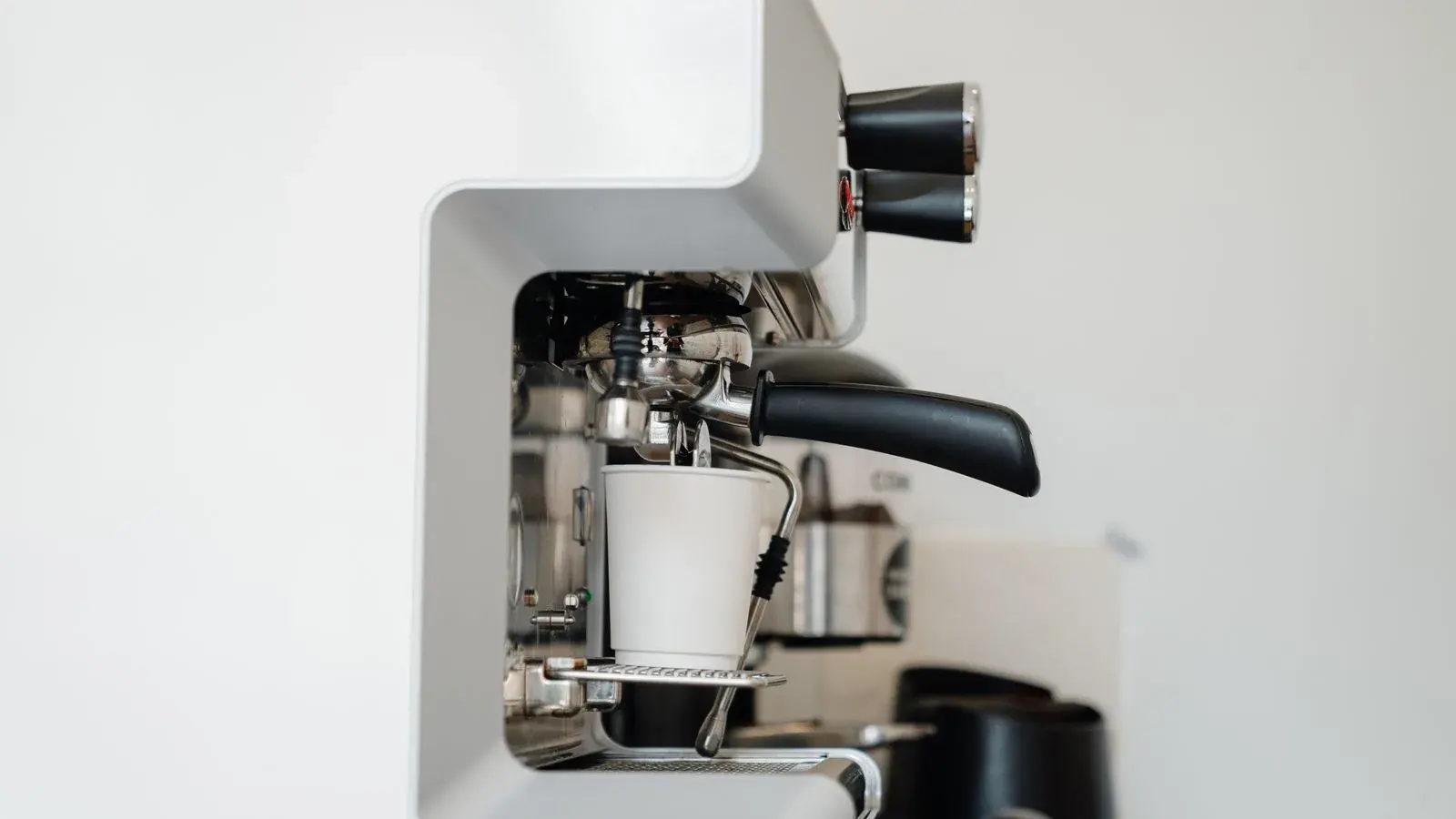
Choose a small espresso knock box if you empty it after each short session. Choose a larger one when several drinks and dial-in shots must fit before you can empty it. Measure room to use and lift the box, as well as its stored size.
Start with the space beside your machine
Measure the free counter patch after allowing room for your grinder, scale and machine care. A knock box catches the spent coffee puck, the bed of grounds left after brewing. Its crossbar gives the portafilter, the handle holding the coffee basket, a place to strike.
You need access above the bar and a clear route to lift the container out. A box tucked under a shelf might fit while stored and still be awkward to empty. The counter has other jobs, too.
If your whole setup is still taking shape, use the small-kitchen machine guide first. Choose the accessory once you know which space is actually free.
Compare the actual boxes
Use exact model dimensions before choosing a size label. Breville's U.S. pages list these two freestanding examples, checked October 20, 2026. They illustrate the space decision; we haven't tested either one.
| Published detail | Knock Box 10, BEA501BSS0ZNA1 | Knock Box 20, BEA502BSS0ZNA1 |
|---|---|---|
| Width | 4.4 in | 6.4 in |
| Depth | 4.8 in | 6.3 in |
| Height | 4.8 in | 6.3 in |
| Maker's capacity claim | Up to 10 espresso pucks | Up to 20 espresso pucks |
| Access for emptying | Removable knock bar | Removable knock bar |
| Base | Anti-slip rubber grip | Anti-slip rubber grip |
Sources: Breville's Knock Box 10 and Knock Box 20 pages. The listed dimensions are width, depth and height. They don't include a measured allowance for your hand or portafilter.
The 10 is the better starting candidate when counter space is tight and you plan to empty it often. Consider the 20 when a longer session calls for more capacity and its larger body fits. Neither removable-bar claim establishes that one is quieter or easier to wash.
Try the footprint before ordering
Make a paper template for each box you're considering. This proposed check uses the published body dimensions above; we have not performed it on a kitchen counter. You only need paper, a ruler and your available-space measurements.
- Mark a rectangle using the maker's width and depth. Write the listed height beside it.
- Put the template in the free patch beside your setup. Check that it leaves access to the water tank, drip tray and grinder controls.
- With the machine off and cool, check the height under any shelf. Leave room to hold the portafilter over the future bar without striking a shelf or appliance.
- Check the route for lifting out the full container and removing its bar. Ask the seller for the removal clearance if you can't confirm it from the instructions or a display unit.
- Compare both templates before adding anything to your cart. If neither leaves a comfortable space to work, move the planned box location or consider another documented size.
Do not swing or strike a portafilter against a paper template. For actual puck removal, follow your exact machine's instructions for ending extraction, releasing pressure and handling hot parts. Stop if the basket remains pressurized or the safe removal procedure is unclear.
Keep the smaller template if both suit your session and it leaves more usable counter. The larger one earns its space only when you'll use the extra capacity.
For a hypothetical free patch 5 in wide and 6 in deep, Breville's listed 10 body fits the rectangle; the 20 exceeds both limits. That makes the 10 a candidate, with height and removal access still to check. Rotating the larger template won't solve this example because both of its sides exceed 6 in.
You can also compare the listed rectangles: 4.4 × 4.8 = 21.12 square inches for the 10, versus 6.4 × 6.3 = 40.32 for the 20. The larger bounding rectangle is about 1.91 times the area. These calculated rectangles help you reserve space; they don't measure the bases or prove either box works under a shelf.
Count a session, including the extra shots
Count the pucks you expect between planned emptying points. Include shots used to adjust the recipe, called dialing in, and drinks for guests. The number on the box won't tell you when to wash it.
For a hypothetical morning, assume each of four drinks uses its own freshly dosed and brewed basket. Those four basket loads plus two dial-in basket loads would leave six pucks: 4 + 2 = 6. That falls below Breville's published up-to-10 claim, but it doesn't prove the actual usable capacity for your basket and dose. If your session approaches the stated maximum, plan an earlier emptying point or compare the larger box.
Choose an emptying routine you can keep. A larger container gives you room during the session; it doesn't establish a safe storage period for wet grounds. We haven't measured odor, mold growth or cleaning intervals.
Confirm care before choosing
Read the care instructions for the exact model before deciding how you'll wash it. Both Breville pages describe a removable bar for access to the inner vessel. Neither checked page provides a washing method, detergent instruction or dishwasher approval.
Ask for those instructions if dishwasher use is part of your buying decision. Do not transfer a cleaning claim from an older Breville box, another size or an unrelated seller listing. Leave the purchase undecided until the care method suits your routine.
If you're choosing a box because the puck looks unusually wet, check the wet-puck guide before buying. A container choice won't establish why the shot behaved differently.
Check machine,grinder and refill space before assigning the remaining counter patch to a knock box.
Plan space for the whole setup
About Mara Ellis
Warm, practical, and lightly witty, Mara turns coffee jargon into clear choices for your counter, budget, and next shot.
Read the profile and guides by Mara Ellis →Sources (2)
- Knock Box 10 US product pageBreville · Checked October 20, 2026(opens in a new tab)
- Knock Box 20 US product pageBreville · Checked October 20, 2026(opens in a new tab)
See an old price or conflicting detail? Send a correction.
How we researched this
We compared the two current Breville U.S. product pages on October 20, 2026. Our contribution is the footprint check and session tally. We have not owned, physically tested or measured these boxes, and we make no taste-test claim. Noise, stability under impact and washing performance remain unverified.
Prices and stock remain unverified. The photograph shows an espresso machine and cup, rather than either identified knock box. Keep your counter measurements and the exact care instructions beside you when you choose.
What the evidence labels mean
- Source checked
- A cited source stated this fact when Espresso Receipt checked it. This is not a physical product test.
- Estimated
- This is calculated from stated inputs and assumptions. It is not a measured result or a current quote.
- Observed physical test
- This is a hands-on result for the exact unit under a stated test method.
- We could not confirm this
- The available sources do not establish one reliable answer.