
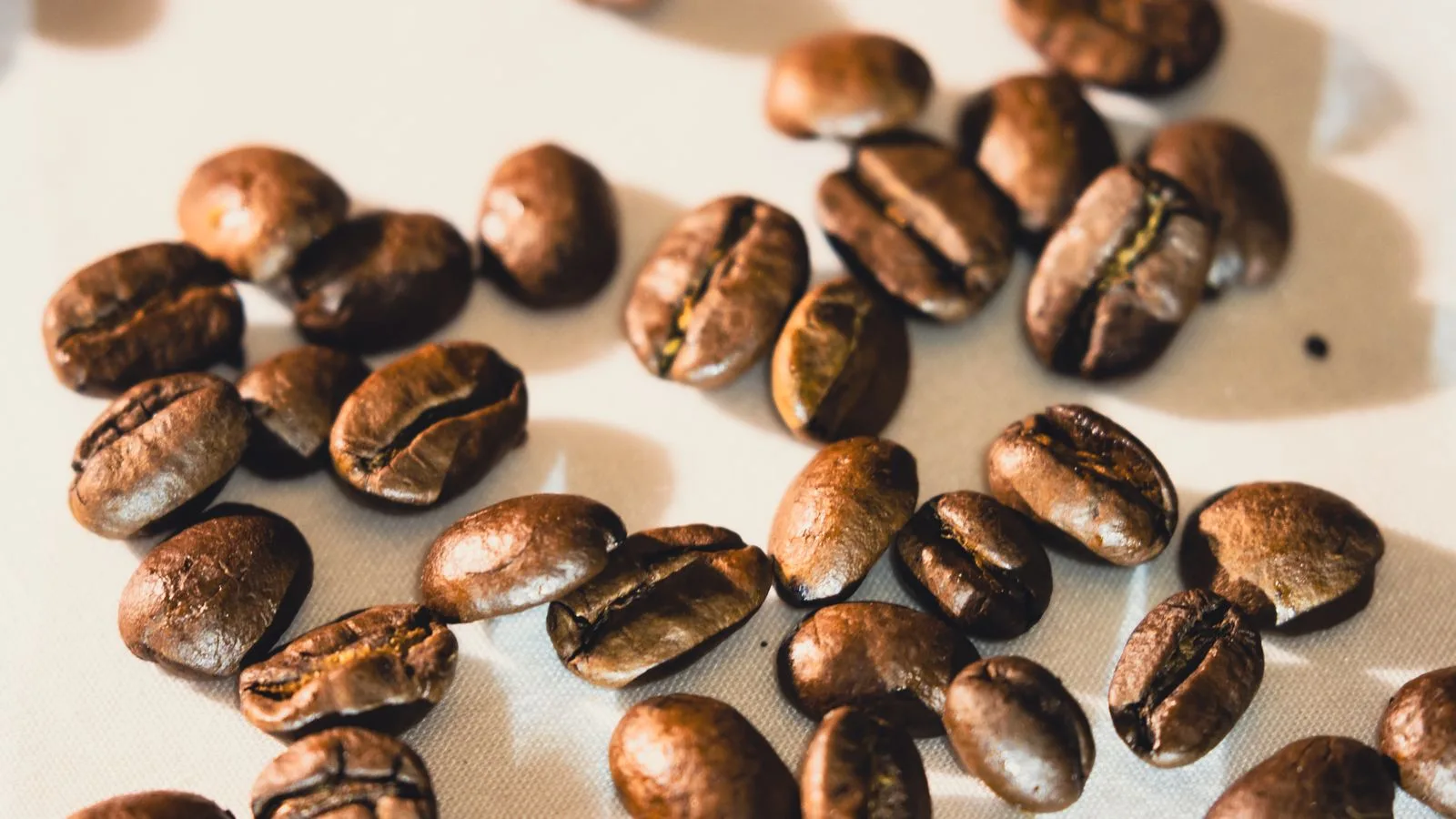
Best first espresso beans: a fresh medium or medium-dark blend
For your first bag, buy a 12-ounce medium or medium-dark blend from a roaster that prints the roast date. Buy it from the roaster or a local shop where you can check that date before paying. Start adjusting the recipe about one week after roasting. Buy the same coffee again so you can learn what your equipment changes.
This gives a new setup a steady starting point. A medium or medium-dark blend is usually easier to use with large grinder steps and limited temperature control. A 12-ounce bag is small enough for many homes to finish while it still brews in a predictable way.
Check the roast date first
A "best by" date tells you when a roaster stopped guaranteeing the product. A roast date tells you how old the coffee is now. These dates are not interchangeable. The roast date is the useful one for espresso.
Roasting puts carbon dioxide into the bean. The bean releases that gas for days. This is why fresh coffee bags have one-way valves and why an espresso puck can behave strangely in the first week. Clive Coffee describes the first week after roasting as the most active period for CO₂. The remaining gas can add carbonic acid and harsh, dry flavors under pressure.
Espresso is especially sensitive because it brews under pressure and for a short time. A filter brew has more time and a coarser bed to handle the gas. A 25-to-32-second shot through a fine puck does not. The same coffee can make a foamy, fast, uneven shot on day two and a steady shot on day nine. Your equipment may not have changed.
A puck is the packed coffee in the basket. Its shape and resistance affect how water moves through the shot.
If a bag has no roast date, you do not know its age. That is a good reason to pass. It tells you more than a flavor description on the front of the bag.
How long to wait before pulling shots
There is no one correct waiting time. The published ranges are close enough to give you a useful starting plan.
| Use | Commonly published rest window | Why the window differs |
|---|---|---|
| Espresso, dark roast | About 3–7 days | More porous beans release CO₂ faster |
| Espresso, light roast | About 5–10 days | Denser structure holds gas longer |
| Espresso, general starting plan | About 7–11 days | Clive Coffee's stated ideal band |
| Drip and pour-over | About 4–7 days | Brewing without pressure tolerates more gas |
| Cold brew | About 10–14 days | Long contact time changes the downside |
Use these published ranges as a starting plan, not a fixed schedule. A coffee can be excellent on day five and still improve on day twelve.
The practical point matters more than the exact numbers. If you buy a bag on roast day and spend three days adjusting it, the coffee keeps changing. You may blame the grinder for the change. Note the roast date. Start the recipe-adjustment steps when the coffee is in a reasonable window.
When steady shots suddenly run fast or taste flat several weeks later, age may be one cause. Grind and puck preparation may also have changed. Use the shot diagnosis questions to find the cause faster.
What arabica and robusta labels tell you
The species label is one of the few details a bag states clearly. It gives useful information.
Whole Latte Love's comparison lists differences that matter at home. Robusta has roughly twice the caffeine of arabica. It often makes more crema in espresso blends, grows at lower altitudes with better pest resistance, and costs less. Arabica is described as more delicate and complex, and more expensive. Robusta makes up roughly 40 percent of world production.
Two useful points follow.
First, robusta is not a defect. Traditional Italian-style espresso blends use it on purpose. Some blends publish their ratios: Lavazza Super Crema is 60/40 arabica to robusta, and Gaggia Intenso is 65/35. If you want heavy crema, fuller body, and a lower price, a blend with robusta is a sensible choice.
Second, "100% arabica" is a species claim, not a quality claim. It does not tell you the altitude, processing, roast date, roasting skill, or whether the lot suits espresso. A stale 100% arabica bag makes worse espresso than a fresh blend.
If you drink milk drinks, you may notice the crema and body from a robusta blend more than in a straight shot. If you drink straight espresso and want origin flavors, a well-sourced arabica gives you more to taste. Both are preferences, not measurements.
Blend or single origin: which is easier first?
A blend combines coffees to reach a repeatable target. A single origin comes from one defined place or lot. It can change between harvests.
For a first bag, a blend is usually easier to learn with. The roaster tries to make this year's bag taste like last year's. That stability helps you tell whether a bad shot came from the coffee or from your process.
Try single origins after your process is steady. When dose, yield, and puck preparation stay the same, you can taste origin differences more clearly. Before then, a new origin in every bag means you must learn the grinder again each week.
Counter Culture Coffee's espresso guide takes a useful position. The roaster does not name one coffee an "espresso roast." It follows an "any coffee, any brew" approach. It tells customers to choose by taste: a dark, chocolatey blend or a bright, fruity coffee can both work as espresso.
This corrects a common assumption. "Espresso" on a bag is a suggestion about roast style and use. It is not a certification. A bag without that word can still work well.
Roast level changes the recipe, not only the flavor
Roast level can surprise a new owner because it changes how the equipment behaves, not only how the coffee tastes.
Darker roasts are more porous and dissolve more easily. They usually grind more easily, release gas faster, and brew more readily. This can be more forgiving with a grinder that has large steps or a machine with limited temperature control.
Lighter roasts are denser and dissolve less easily. They often need a finer setting, more rest, and more precise changes so they do not taste sharp and thin. A grinder that cannot make small repeatable changes can make a light roast frustrating. That is a hardware limit, not a failure of the coffee.
Let your grinder guide your bean choice. With a stepped grinder such as the Baratza Encore ESP, a medium to medium-dark roast will more often fit the available settings. A grinder with a continuous dial gives you smaller adjustments, so lighter roasts become easier to try.
When you change roast level, expect to change the grind setting. You may need more than one click. The espresso grind size chart explains why settings do not transfer between grinders or coffees.
Turn bag price into cost per drink
Bean price is a repeating cost. It is easy to calculate.
An 18-gram dose is about 0.0397 pounds. Multiply that by the price per pound to get the coffee cost for one drink.
| Bag price and size | Price per pound | Coffee cost per 18g dose |
|---|---|---|
| $14 / 12 oz | $18.67 | $0.74 |
| $16 / 12 oz | $21.33 | $0.85 |
| $18 / 12 oz | $24.00 | $0.95 |
| $22 / 12 oz | $29.33 | $1.16 |
| $20 / 2 lb | $10.00 | $0.40 |
The Finder's planning profile uses $16 per pound and an 18-gram dose. That gives about $0.63 of coffee per drink. The espresso cost-per-cup calculator starts with a separate editable example and lets you enter your actual bag price, bag weight, and dose. Neither model claims your roaster's price.
This math often leaves out two costs. First is adjustment waste: shots you discard while finding a setting for a new bag. Second is the small amount of coffee you may run and discard to clear old grounds after an adjustment. Each cost is small but real. Both are highest when you are learning and buying many bags.
The useful question is not "expensive beans versus cheap beans." Ask whether the difference per drink—often 20 to 50 cents—is worth more to you than spending that money elsewhere in your setup. The math informs this choice, but it cannot make it for you.
Where you buy changes what you can check
The main difference between sellers is whether you can see the roast date before you pay.
Roaster-direct sellers show roast dates most often. They may roast after you order. Shipping adds cost and time, which uses part of the waiting window. If your home uses a bag every week or two, a regular roaster-direct order is often the simplest choice.
Local roasters remove shipping and let you inspect the bag first. Check how quickly bags sell. A small roaster with slow sales may have older bags than a busy roaster.
Grocery and big-box stores often have the lowest price per pound and the least information. Many bags show only a best-by date. Some specialty products also show a roast date. This option can work if you check that date and accept that the coffee may be older.
Subscriptions solve the timing problem: coffee arrives before the last bag goes stale. You give up some choice over each coffee. They suit steady drinkers more than people who want to explore.
No seller is always best. Each balances price, information, freshness, and choice. The best option depends on how fast you drink the coffee.
Buy a bag you can finish while it is fresh
For occasional decaf use, the decaf espresso guide adds a bag-size calculation and explains what the process label can tell you.
Bag size affects freshness as much as price.
The National Coffee Association's storage guidance is direct. Coffee starts to lose quality soon after roasting. Buying smaller amounts every one to two weeks keeps it fresher than buying in bulk. It lists roughly one to three weeks of useful room-temperature life for whole beans and one to two weeks for pre-ground coffee.
Start with how much you drink. At two drinks a day and an 18-gram dose, a 12-ounce bag lasts about nine days. At one drink a day, it lasts about eighteen days. A five-pound bag at two drinks a day lasts roughly two months. That is well past the window when the coffee usually tastes best.
The per-pound saving on a large bag is real. So is the loss of quality during the later part of the bag. If you buy in bulk, freeze the coffee in portions from the start.
Store the coffee you bought
Storage cannot improve coffee. It can only slow quality loss.
The NCA says to protect coffee from air, moisture, heat, and light. It recommends an airtight, opaque container. Clear canisters let in light and can harm taste. Its published guidance also lists roughly three to four months of retained freshness for properly sealed frozen beans. It recommends grinding just before brewing.
Grinding just before brewing is one of the biggest actions a home brewer can take. Ground coffee exposes much more surface area to oxygen. This is why the NCA's shelf-life table gives pre-ground coffee a shorter window than whole beans. It is also why pre-ground espresso can lose the freshness you paid for.
A workable routine for espresso:
- Keep the working bag sealed, opaque, at room temperature, away from the machine's heat.
- Do not refrigerate the working bag; condensation and odor transfer are real risks.
- Freeze only in sealed portions you will not repeatedly thaw.
- Grind immediately before each shot.
- Record the roast date somewhere you will see it when shots start behaving differently.
Do not worry about vacuum canisters or inert gas until you do the basics. A sealed opaque container and a bag you finish within two or three weeks provide most of the benefit.
Buy the same bag again
The second bag helps you learn your equipment because the coffee is no longer a new variable. Use the espresso ratio calculator to set a target yield. Hold the dose steady and change only the grind.
After that, change one part of the purchase at a time. This makes differences in species, origin, roast, or price easier to identify.
Before you buy, write down your drink, grinder, weekly use, and budget. Then check the roast date, bag size, and starting recipe. This short list keeps a promising flavor description from hiding a coffee that will age before you finish it.
You are choosing what to brew, so continue with the owner path instead of restarting a machine-shopping quiz.
Choose a forgiving first coffee →Products mentioned
Open a product to see its exact source, checked date, known uncertainty, dimensions, and main downside.
Common questions
How long should coffee rest before espresso?
Published retailer guidance clusters around 5–11 days after roasting, with darker roasts often ready sooner and lighter roasts often needing longer. Treat it as a reason to wait rather than a fixed schedule.
Do I need beans labeled espresso roast?
No. Counter Culture Coffee deliberately declines to designate espresso roasts and directs customers to choose by taste. The label describes intended style, not suitability.
Is 100% arabica better for espresso?
It is a species claim, not a quality claim. A fresh blend containing robusta will make better espresso than a stale 100% arabica bag, and robusta contributes crema and body that some drinkers prefer.
How much does espresso coffee cost per drink?
An 18g dose is about 0.0397 pounds, so multiply your bag's price per pound by that figure. At $16 per pound the coffee cost is roughly $0.63 per drink before dial-in waste.
How we researched this
- Page length
- 2,107 words
- Reading time
- 10 minutes
- Sources used
- 8
- Products mentioned
- 2
- Article updated
We use published product details, dated price checks, and labeled estimates to help you decide. We label a hands-on result as an observed test only when we name the exact product and test it. A checked price is not a current quote or your final delivered total.
What the evidence labels mean
- Source checked
- A cited source stated this fact when Espresso Receipt checked it. This is not a physical product test.
- Estimated
- This is calculated from stated inputs and assumptions. It is not a measured result or a current quote.
- Observed physical test
- This is a hands-on result for the exact unit under a stated test method.
- We could not confirm this
- The available sources do not establish one reliable answer.

About Mara Ellis
Mara Ellis is Espresso Receipt’s fictional editorial voice. Warm, practical, and lightly witty, she turns coffee jargon into clear choices for your counter, budget, and next shot.
Read the profile and guides by Mara Ellis →Sources used
We use manufacturer, standards group, government, and authorized-retailer records when available. Open a source to read the original details.
- Guide to espressoCounter Culture Coffee · Check date not recorded(opens in a new tab)
- Is your coffee too fresh?Clive Coffee · Check date not recorded(opens in a new tab)
- Coffee storage and shelf lifeNational Coffee Association · Check date not recorded(opens in a new tab)
- Arabica vs. Robusta coffee beansWhole Latte Love · Check date not recorded(opens in a new tab)
- Coffee standards and protocolsSpecialty Coffee Association · Check date not recorded(opens in a new tab)
- Espresso Receipt methodologyEspresso Receipt · Check date not recorded
- Encore ESP product pageBaratza · Espresso Receipt checked this source on 2026-09-07(opens in a new tab)
- DF54 v1.5 product pageMiiCoffee · Espresso Receipt checked this source on 2026-09-07(opens in a new tab)
See an old price or conflicting detail? Send a correction.