
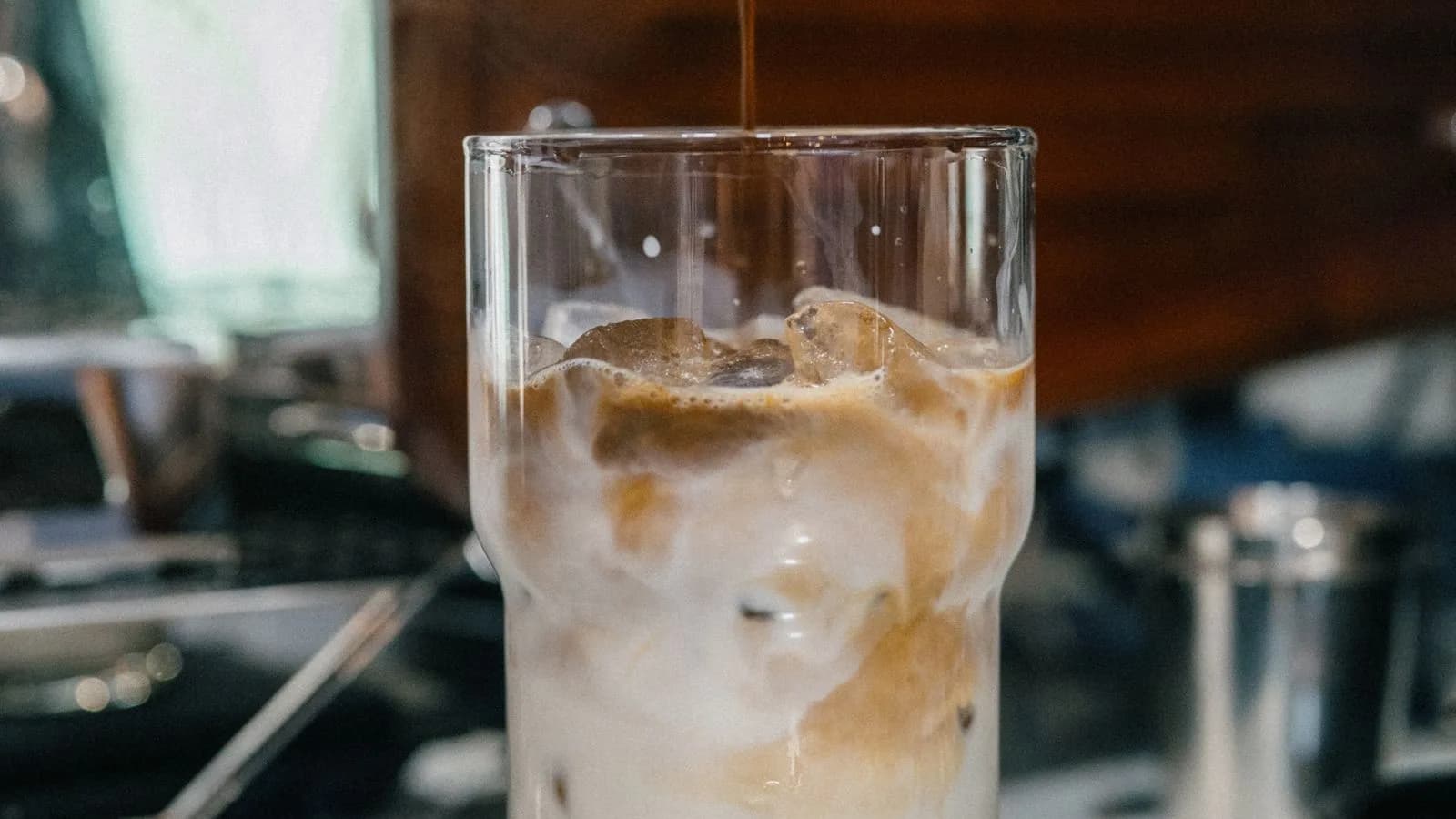
To make an iced latte, combine espresso, cold milk, and ice in a glass with room to stir. For a measured starting drink, Nespresso's iced-latte recipe uses two Ispirazione Ristretto Italiano or Master Origins India capsules, each prepared as a 40 mL espresso, 100 mL milk, and three ice cubes. Make that version first if you have the specified capsules. If you use an espresso machine, pull your usual double shot and use the milk amount as a starting point; record the coffee you actually made rather than calling it the same 80 mL drink.
That distinction matters when you want to repeat the cup. Breville's iced-latte method also uses a double espresso, cold milk, and ice, but it does not give a measured milk amount or ice weight. The table gives you Nespresso's complete measured method and shows where the Breville version leaves a choice to you. Neither maker says there is one fixed iced-latte ratio for every machine or glass.
Choose a starting cup
Set out a clear drinking glass, cold milk, ice, and a cup for the hot coffee. Use your coffee maker as its own instructions require. The ice and milk go into the serving glass; brew the coffee in a separate cup or jug unless your machine's instructions say it can dispense safely into your chosen glass.
| Starting method | Coffee | Milk | Ice | Best use |
|---|---|---|---|---|
| Nespresso's measured capsule recipe | Two Ispirazione Ristretto Italiano or Master Origins India capsules, each prepared as a 40 mL espresso | 100 mL cold milk | Three cubes or crushed ice | Repeat its stated amounts, then change one amount after tasting. |
| Breville's espresso-machine method | A double espresso made with its machine procedure | Cold milk; amount not stated | A handful of cubes; weight not stated | Use your usual double shot, measure the milk you choose, and note how much ice fits. |
The rows are separate published methods. A 40 mL capsule extraction is a volume. Your machine may instead help you measure a double shot by drink weight in grams. The numbers cannot be exchanged without measuring the actual drink. Breville's 18–22 g of ground coffee and roughly 30-second extraction are details of its pictured machine method, not requirements for every espresso maker.
For the first version, use Nespresso's capsules and amounts if they match your equipment. For an espresso machine, use its basket, dose, and operating instructions. Then measure 100 mL cold milk as a trial amount, label it as your adaptation, and decide after the first sip whether you need more or less. This keeps the source recipe and your own experiment separate.
Make the measured capsule version
Measure 100 mL cold milk into the serving glass. Nespresso's method prepares two Ispirazione Ristretto Italiano or Master Origins India capsules as 40 mL espresso extractions, pours the coffee over the milk, then adds three ice cubes. Follow the capsule machine's instructions for the coffee. Handle the hot cup and coffee carefully while you transfer them.
Add the ice gently, leaving space below the rim. Stir if you want the coffee and milk evenly mixed. Taste while the ice is still present, then note whether the coffee flavor is clear enough for you.
Nespresso also permits crushed ice. Its recipe does not give an ice weight or final glass volume, so check the space in your own glass.
If the glass looks too full before you add the ice, stop pouring. Use a larger glass or move the drink to one with more space. The aim is a cup you can hold and stir without spilling, not a drink pressed to the rim. If you use a small glass, put in less milk only if you are willing to change the source recipe and record that change.
The order can vary. Breville puts cold milk and ice in the glass, makes a double espresso separately, then pours it over the milk and ice. Starbucks at Home puts ice and freshly brewed coffee in the glass before adding milk. Use the order your equipment supports. Keep it the same when you compare your next cup.
Leave room for ice
The Nespresso amounts give a simple planning check. Two 40 mL coffee extractions total 80 mL. Add 100 mL milk and you have 180 mL of liquid before the ice goes in.
Ice displaces liquid, so this sum does not tell you the final fill line. Nespresso does not state the cubes' size or how much they will melt while you make the drink.
Imagine that your glass holds 300 mL to its rim. The 180 mL liquid leaves a nominal 120 mL for ice and empty space. That is a hypothetical capacity check. It cannot prove that three cubes fit.
Put the milk in first, add the coffee as the recipe instructs, and check the space before the cubes. If the ice would raise the drink to the edge, use a taller glass. Leave a visible margin below the rim.
For the Breville method, there is no 180 mL figure to copy because its page does not give the milk amount. Pour your selected milk into a measuring cup first. Make the double espresso and note its yield using the unit your machine gives. Build the glass with space for ice. If you weigh the espresso in grams, keep that number in grams; do not add it to milliliters of milk as though the units were the same.
This small check is useful even when you make only one drink. You can write down the glass size, milk volume, coffee yield, and ice count. On the next cup, those notes tell you which part changed. A café serving size or a photo cannot supply that information for your glass.
Change the next cup from what you taste
Stir and taste before you adjust. If the coffee seems faint, keep the same coffee and ice and use less milk on the next cup. If it is stronger than you want, add a little cold milk now, note the new total, and use that total next time. Write down which cup you prefer.
Suppose you make Nespresso's two-extraction version with 100 mL milk and three cubes. You decide that you want more coffee flavor. On your next cup, keep the same coffee and three cubes but start with 80 mL milk. The difference is 20 mL less milk.
Write down both amounts and which cup you prefer. If the second cup is too strong, try an amount between them on another day. This is a hypothetical comparison, not a published Nespresso variant.
If the espresso itself tastes sharp or bitter before it meets the milk, work on the coffee first. Our espresso dial-in guide explains how to change one brewing variable at a time. The espresso ratio calculator helps when you use a dry coffee dose and a target drink weight; it does not calculate how much ice fits in a glass. Keep the milk and ice amounts steady while you change the coffee.
If the drink tastes thinner as it sits, note how long you left it before drinking and whether the ice has melted. You can make the same ingredients again and compare an earlier sip with a later one. Do not claim the coffee itself changed when the glass also contains more melted ice. A large change in ice amount makes a milk adjustment harder to judge, so start with the same count or measured ice mass each time.
Keep the method plain
Cold milk is enough for this drink. Breville explains that an iced latte does not need steamed milk. Its recipe uses cold milk and a double espresso. Warm milk melts ice.
If you want foam, use a cold method that your frother's manual permits. Do not use a hot steam program just to copy a photo.
For a warm cup with lightly textured milk, use the separate hot latte recipe. Its milk and cup method answer a different question; it is not a way to measure ice for this drink.
Dairy milk is an allergen. You can choose a milk alternative that suits you, but its flavor and texture can change the cup. Record the product and amount before comparing results. The measured Nespresso recipe names milk and the Breville method names cold milk; neither source here establishes an identical result for every substitute.
Sweetener is optional in Starbucks' iced-latte recipe. The plain starting cup above has none. If you add syrup or sugar, measure it and record it separately. A sweetener can change what you notice in the coffee, so taste the plain version once if you want a useful baseline. Do not describe a flavored variation as the same measured three-ingredient cup.
The photograph shows a layered milk coffee with ice in a clear glass. It cannot verify its coffee dose, ingredients, cup capacity, or taste. The source methods were read on September 27, 2026. We did not physically test, own, prepare, taste, or measure this drink or the equipment. Use your machine's operating and cleaning instructions for its hot parts and shutdown steps.
Make one plain cup, record what went into your own glass, and keep the amounts that tasted right. A short note makes the next iced latte easier to repeat.
Use the coffee guide when the plain shot tastes sharp or bitter before milk is added.
Keep the espresso base repeatable
About Mara Ellis
Mara Ellis is Espresso Receipt’s fictional editorial voice. Warm, practical, and lightly witty, she turns coffee jargon into clear choices for your counter, budget, and next shot.
Read the profile and guides by Mara Ellis →Sources (4)
- Iced LatteNespresso · Checked 2026-09-27(opens in a new tab)
- Iced LatteBreville · Checked 2026-09-27(opens in a new tab)
- How to make a latte: 3 easy stepsBreville · Checked 2026-09-27(opens in a new tab)
- Iced Latte RecipeStarbucks Coffee at Home · Checked 2026-09-27(opens in a new tab)
See an old price or conflicting detail? Send a correction.
How we researched this
We use manufacturer, standards group, government, and authorized-retailer records when available. We label a hands-on result as an observed test only when we name the exact product and test it. A checked price shows what the seller listed on the check date. It can change after that date, and your delivered total may differ.
What the evidence labels mean
- Source checked
- A cited source stated this fact when Espresso Receipt checked it. This is not a physical product test.
- Estimated
- This is calculated from stated inputs and assumptions. It is not a measured result or a current quote.
- Observed physical test
- This is a hands-on result for the exact unit under a stated test method.
- We could not confirm this
- The available sources do not establish one reliable answer.