
An espresso dosing funnel sits on the basket while you move ground coffee into a portafilter. It can keep loose grounds on the counter from becoming waste. Choose one only after you check the basket rim, the space under your grinder, and the maker's instructions for tamping. Two funnels marked 54 mm can give you different routines.
A funnel is most useful when coffee spills as you grind into the basket, pour from a dosing cup, or stir loose grounds with a Weiss Distribution Technique (WDT) tool. It does not set the right dose or make a poor shot taste better by itself. If your current routine is clean and repeatable, you can keep it.
Start with the spill you want to stop
Watch one normal preparation before buying a funnel. Notice whether coffee misses the basket at the grinder outlet, spills from a dosing cup, or falls from the rim while you stir. That tells you where the funnel needs to sit and how much open space it needs.
A ring that stays on the portafilter in a grinder cradle may help direct grinding. A taller ring may give a WDT tool more room above the coffee. Neither feature proves that the ring fits your grinder fork, basket, and tamper together.
Breville's Dosing Funnel is designed for named 54 mm Breville portafilters and their grind cradle. Crema's 54 mm funnel also names several Breville 54 mm portafilters, but Crema says the Barista Express portafilter holder cannot be used with its funnel installed. The shared 54 mm label does not settle grinder clearance.
If you grind into a cup and pour into the basket, check that the cup's lip can enter the funnel opening without catching. You can also set the portafilter on a stable stand and pour slowly. Do not hold an unstable basket in one hand while using a grinder or a pointed WDT tool with the other. You can skip the funnel if a slower pour already keeps the dose in the basket.
Check the full fit before you order
Start with your exact portafilter and basket. The machine's group size narrows the search. Use the seller's stated compatibility to check a particular funnel.
Look for your machine model and basket system on the maker's page. Then check how the ring sits on the rim: an outer-rim design and a ring that enters the basket can leave different working space at the coffee edge. Decent describes its 58 mm funnel as sitting outside the basket. That is a feature of Decent's product, not a promise about every 58 mm funnel.
Next, check the grinder path. A portafilter must reach the grind outlet with the funnel attached if you plan to grind directly into it. Check the fork or cradle, the outlet height, and how you start and stop grinding.
With the grinder off, place the funnel on a cool, empty basket and bring the portafilter to its normal grinding position. Check that the fork still supports the handle and the outlet points into the opening. Remove the funnel if metal or plastic touches the outlet or holder in a way the maker does not allow.
Do not force it through a tight space. The Crema and Breville example below shows why you need the exact accessory's instructions, even when the portafilter diameter matches.
| Named funnel and source | Stated basket fit | Grinder or tamping rule | Decision it supports |
|---|---|---|---|
| Breville Dosing Funnel | Breville 54 mm portafilters, including listed Barista Express, Pro, and Touch models | Breville says it works in those machines' grind cradle and permits tamping with the funnel attached | Check your exact Breville model against Breville's list before using this routine. |
| Crema 54 mm Dosing Funnel | Named Breville/Sage 54 mm models and 54 mm Solis machines | Crema says the Barista Express portafilter holder cannot be used while its funnel is installed | Choose a different way to support the portafilter if that holder is central to your routine. |
| Decent 58 mm Portafilter Funnel | Standard 58 mm baskets named by Decent | Decent lists a 12 mm short version for spouted portafilters and a 29 mm tall version for bottomless setups; it says to wash the funnel by hand | Check basket fit and the space above your exact portafilter before choosing a height. |
Use the table as a comparison of three named products, not a universal size chart. The portafilter size finder can help you identify your machine's listed basket family.
It cannot confirm that a particular funnel clears your grinder or supports tamping through it. If the maker does not list your combination, ask the maker before ordering. Keep the answer with your machine and basket details.
Keep the preparation steps in order
For a compatible Breville Barista Express funnel, Breville's instruction book says to attach and twist the funnel onto the portafilter, place the portafilter in the grind cradle, dose, and tamp. The book then tells you to remove the funnel before you insert the portafilter into the group head. This is a model-specific sequence. Do not copy its tamp-through step to an unrelated ring unless that ring's maker allows it.
A practical preparation sequence is to seat the basket, attach the approved funnel as its maker directs, and add your usual measured dose. Keep the portafilter steady. If you use WDT, stir only while the funnel and basket are stable, then follow the WDT guide for that separate step.
Remove the tool and check for loose parts. Level or settle the grounds as your routine requires. Tamp only as the funnel maker permits, and remove the funnel before brewing unless the machine's instructions explicitly say otherwise.
Do not increase the coffee dose just because the funnel holds a taller mound of loose grounds. The basket's intended dose and the space above the tamped coffee still matter.
If the portafilter resists locking, leaks, or behaves differently after you add an accessory, stop. Follow the machine manual to stop brewing and let the group depressurize before you remove the portafilter. Do not force the handle into place.
Clean the funnel by its own instructions. Breville calls its funnel dishwasher safe on the accessory page, while the BES870 manual tells owners to hand wash all machine parts and accessories. Those instructions conflict; check the instructions supplied with your exact funnel, and hand wash if they do not resolve the conflict. Decent says to hand wash its metal funnel.
Turn off and unplug the machine before cleaning it when the manual requires that step, and let hot parts cool before handling them. Store the loose funnel where it will not fall into the grinder or onto a hot surface.
Try one controlled shot
You can test whether a funnel improves your routine without claiming that it improves espresso flavor. Use your normal basket, coffee, dry dose, grind setting, and target drink weight for two shots. Prepare the first without the funnel.
For the second, add the compatible funnel and keep the rest of the routine as steady as you can. Record the dry coffee that reaches the basket, any spilled grounds, the drink weight, and a short taste note.
Suppose your hypothetical basket is meant for an 18 g dose. You weigh 18.0 g of coffee before grinding, but 0.4 g spills in the first preparation. The basket receives 17.6 g. With the funnel, all 18.0 g reaches the basket.
That is a 0.4 g difference in basket dose, even though the grinder input stayed the same. It can change the shot, so you cannot credit a taste difference to the funnel alone. The immediate result you can trust is whether the transfer became cleaner.
If both shots get the intended dose into the basket, compare the handling. Note whether the ring stayed seated, lifted clear of the grounds, and fit the grinder as its maker intended.
Keep the funnel if cleanup is easier. Put it away if the routine is slower or the ring obstructs your tool. The cup is still the reason for the work.
For a later flavor check, keep the basket dose equal and use the dial-in guide to interpret time and taste. A single faster or slower shot does not prove an extraction benefit from the funnel. Change one variable at a time so your notes say what happened.
Know what the photo and sources cannot show
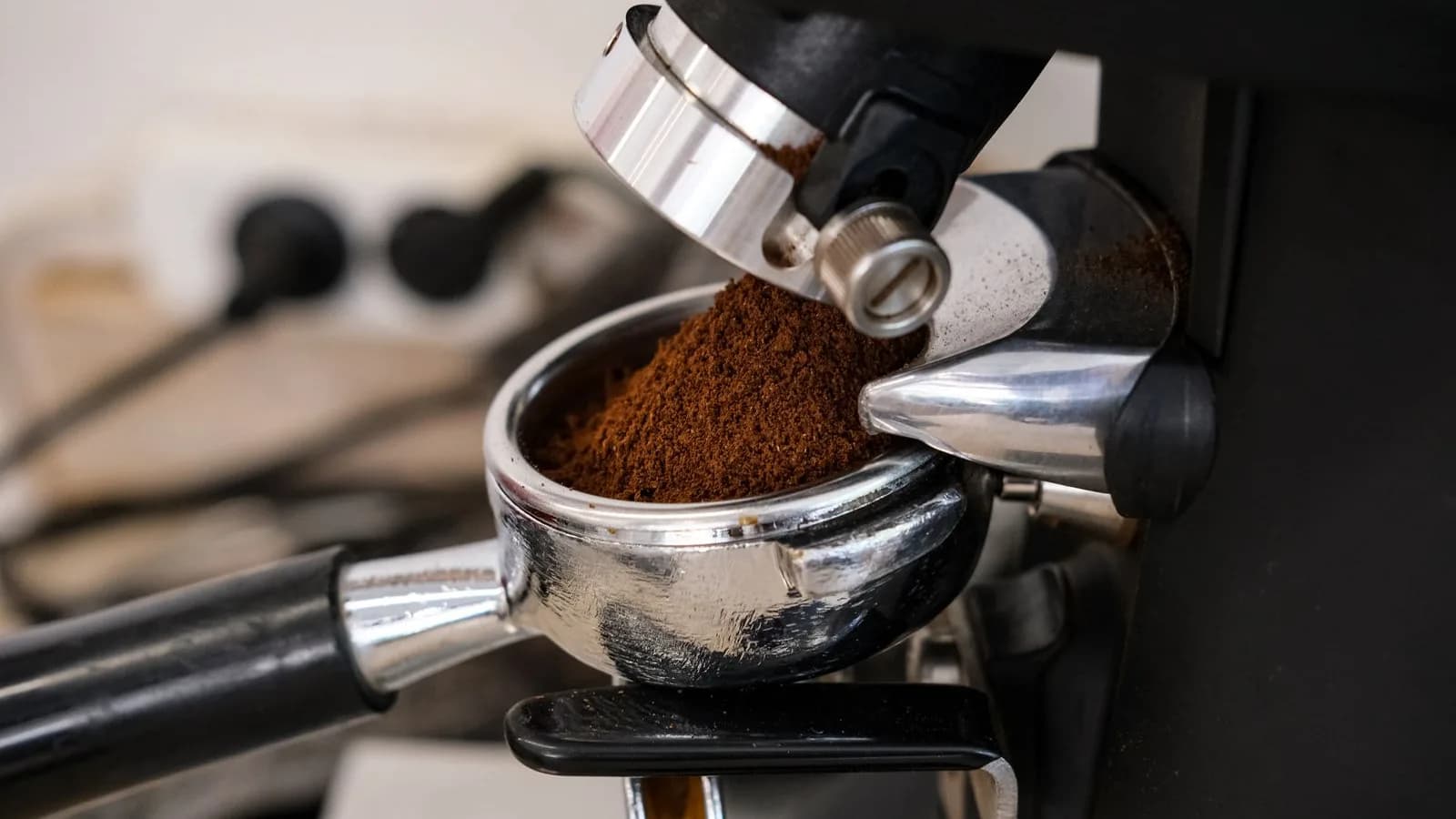
The article photo shows ground coffee falling into a portafilter at a grinder. It does not show a dosing funnel or prove that a specific accessory fits that grinder. The three maker pages support their own compatibility and handling statements.
They do not establish that one funnel improves extraction or taste across machines. We did not own or test these accessories, or taste or measure shots made with them.
Write down your exact portafilter, basket, grinder, and the point where grounds spill. Check the maker's fit and cleaning instructions for that combination. If the evidence matches your routine, try one measured preparation and keep the funnel only if it solves the problem you saw.
Find the listed portafilter size, then confirm the exact funnel and grinder fit with its maker.
Check your basket family
About Mara Ellis
Mara Ellis is Espresso Receipt’s fictional editorial voice. Warm, practical, and lightly witty, she turns coffee jargon into clear choices for your counter, budget, and next shot.
Read the profile and guides by Mara Ellis →Sources (4)
- The Dosing FunnelBreville · Checked 2026-10-02(opens in a new tab)
- Barista Express instruction bookBreville · Checked 2026-10-02(opens in a new tab)
- 54 mm Dosing FunnelCrema Coffee Products · Checked 2026-10-02(opens in a new tab)
- Portafilter funnelDecent Espresso · Checked 2026-10-02(opens in a new tab)
See an old price or conflicting detail? Send a correction.
How we researched this
We use manufacturer, standards group, government, and authorized-retailer records when available. We label a hands-on result as an observed test only when we name the exact product and test it. A checked price shows what the seller listed on the check date. It can change after that date, and your delivered total may differ.
What the evidence labels mean
- Source checked
- A cited source stated this fact when Espresso Receipt checked it. This is not a physical product test.
- Estimated
- This is calculated from stated inputs and assumptions. It is not a measured result or a current quote.
- Observed physical test
- This is a hands-on result for the exact unit under a stated test method.
- We could not confirm this
- The available sources do not establish one reliable answer.