
To make a flat white at home, pull a double espresso and pour in lightly textured warm milk so only a thin layer of fine foam remains on top. For a measured starting cup, La Marzocco Home suggests a double shot and about 4 U.S. fluid ounces of milk to steam at 140–150°F. Measure the milk you add to the cup separately. Pour to taste, record what you used, and change the milk amount on your next drink.
You do not need to settle every café definition before making breakfast. Breville's flat-white method begins with one espresso shot, while La Marzocco uses a double. Both call for a smooth milk texture with less foam than a cappuccino. The recipe below follows the La Marzocco example so you can repeat it and decide whether your cup needs more coffee or more milk.
Set out the cup, coffee, and milk
Choose a heat-safe cup that holds at least 8 U.S. fluid ounces. This working size leaves room to pour. A smaller cup may work if your actual espresso and poured milk fit with space below the rim.
Cup labels can be approximate. Measure the milk before steaming, then weigh what you add to the cup.
La Marzocco's guide gives a general double-shot starting recipe of 18 g ground coffee yielding about 28–36 g espresso in about 25–30 seconds. Its flat-white example then says to steam about 4 fl oz of milk, which is roughly 118 mL, at 140–150°F. The source does not tell us how much of that steamed milk reaches the serving cup. A foam layer should be about 0.5 cm or thinner.
These are published starting points. Espresso Receipt did not measure them in a kitchen.
| What to prepare | Source-based starting amount | What you should record |
|---|---|---|
| Ground coffee | 18 g for La Marzocco's general double-shot example | Your basket's dose and the actual dry coffee mass |
| Espresso in the cup | About 28–36 g from that general example | The drink mass that reaches your cup |
| Cold dairy milk to steam | About 4 U.S. fl oz, or roughly 118 mL | Cold pitcher input in mL; milk and foam added to the cup in g |
| Milk temperature | La Marzocco example: 140–150°F | The temperature if you use a suitable thermometer |
| Top foam | About 0.5 cm or thinner in the source example | Whether the first sip has a thin, smooth top or a thick cap |
Steam changes the milk's texture and volume. If some remains in the pitcher, you have still made the source-based starting drink. To measure what enters the cup, place the cup with its finished espresso on a scale that can hold a hot cup.
Set the scale to zero, then pour milk and foam. Record the new reading in grams as the mass you added.
Keep the cold milk input in milliliters and the poured milk and foam in grams. The two numbers cannot be subtracted to find leftover milk or final cup volume. The scale reading gives you one value to repeat on the next drink.
If your steam pitcher has a minimum fill mark above 4 fl oz, obey that mark and prepare more milk. You can still pour a smaller amount into the drink. Follow the food label and your device instructions for any remainder. Do not return heated milk to the original carton.
Make the starting flat white
Prepare the espresso using your machine's basket and operating instructions. If the basket fits the 18 g example, weigh the dry coffee and aim for a drink mass in the source's 28–36 g range. Otherwise, use the dose your basket or machine specifies and record the drink mass.
A capsule or automatic machine may call a serving a double without exposing a dry dose. In that case, note the program or capsule. Its coffee need not match the 18 g example.
Pull the coffee into your serving cup. A single-heating-element machine usually makes the coffee first and heats milk afterward; Breville says to use that order for its flat-white method. A dual-boiler machine can allow the two jobs at once, but there is no need to race the shot. Keep the same coffee recipe on the next cup so you can judge the milk change.
Measure about 4 fl oz of cold dairy milk into a suitable steam pitcher, provided that amount meets your machine's fill rules. Use the exact machine manual for the steam wand's setup and purging steps. The wand and steam can burn you. Follow the controls and wand positions for your model.
Texture the milk to a smooth, glossy flow with very small bubbles. La Marzocco's flat-white example aims for 140–150°F and a finished foam layer no thicker than about 0.5 cm. Breville also calls for a thin layer and says to swirl and tap the pitcher to remove large bubbles.
Use a suitable thermometer if you want to check the temperature. If your manual sets a different limit, follow your manual.
Stop the steam according to your machine's instructions before you remove the wand from the milk. Keep hands clear of hot metal and escaping steam. Complete the wand cleaning and cooling steps in the same manual after the pour. If you use a separate electric frother, follow its fill marks and shutdown instructions instead of steam-wand advice.
Swirl the finished milk. Put the cup with its espresso on a suitable scale and set the scale to zero. Pour milk into the espresso in a steady stream, then note the grams added. The reading includes any foam you poured.
Sip when it is safe to drink. If the coffee is too intense for you, add a little more milk and record the new total in grams. The cup can have space at the top.
The thin foam layer matters more than a leaf drawn on top. A pour without latte art can still have smooth milk. If the milk separates into stiff foam above thin liquid, swirl the pitcher and pour promptly.
If it stays coarse, use your machine's milk-texturing instructions on the next attempt. Do not try to repair hot milk by placing hands near the wand.
Change the next cup from what you taste
Keep one short note: coffee dose or program, espresso mass, cold milk prepared, milk and foam mass added, and how the first sip felt. Suppose your own first cup uses 18 g ground coffee and produces 32 g espresso. You start with 118 mL cold milk, then steam it as your device instructs. Place the espresso cup on a scale, set the scale to zero, and pour until it reads 90 g.
In this hypothetical case, 32 g espresso plus 90 g added milk and foam gives a 122 g drink if none spills. We chose the 90 g sample only to show how to record the pour and add the masses.
If that cup tastes too coffee-forward for you, keep the 18 g and 32 g coffee recipe and pour a little more of the same milk on the next try. If the coffee disappears, use less poured milk while leaving the espresso recipe alone. Change the grams added to the cup. Taste, then write down the new amount.
Change one thing at a time. Cold milk left in the pitcher does not tell you how much reached the cup.
If the espresso tastes sharp or bitter before the milk goes in, change the coffee recipe instead. Our guide to dialing in espresso explains how grind, dose, and drink weight affect a shot. The espresso ratio calculator can show a target drink mass from a dry coffee dose. Use the scale separately for the grams of milk and foam added to the cup.
The first sip also reports on texture. If you get a large dry cap, introduce less air during the next milk preparation as your model's instructions allow. If the drink is hot milk with no integrated fine bubbles, follow your device's texturing guidance to add a little air.
Hold the coffee and poured-milk amounts steady while you work on texture. You can then tell whether the change helped.
Why another flat white may use a different shot
Breville's page lists one espresso shot and cold milk. La Marzocco Home's guide uses a double shot with about 4 fl oz milk to steam. The two sources offer different starting points. Ask a café for its shot count and cup size if you want to know what it serves.
The milk texture gives you another way to describe the drink. Both pages describe a thin, fine layer instead of a tall foam cap. La Marzocco contrasts its flat-white example with a latte made from a double shot, 8 fl oz milk, and about 1 cm of foam. Those source examples explain why a larger latte can taste milder.
Menus can use other amounts. Use flat white versus latte when you need to choose an order; use these measured notes when you make one.
Some flat-white versions use a shorter espresso called a ristretto; the two starting methods above do not require it. If your machine has a ristretto control, use its own instructions and record the result before comparing drinks. Our ristretto versus espresso guide explains what changes in the coffee base. Keep the shot type in your note so you can tell whether a later taste change came from the coffee or the milk.
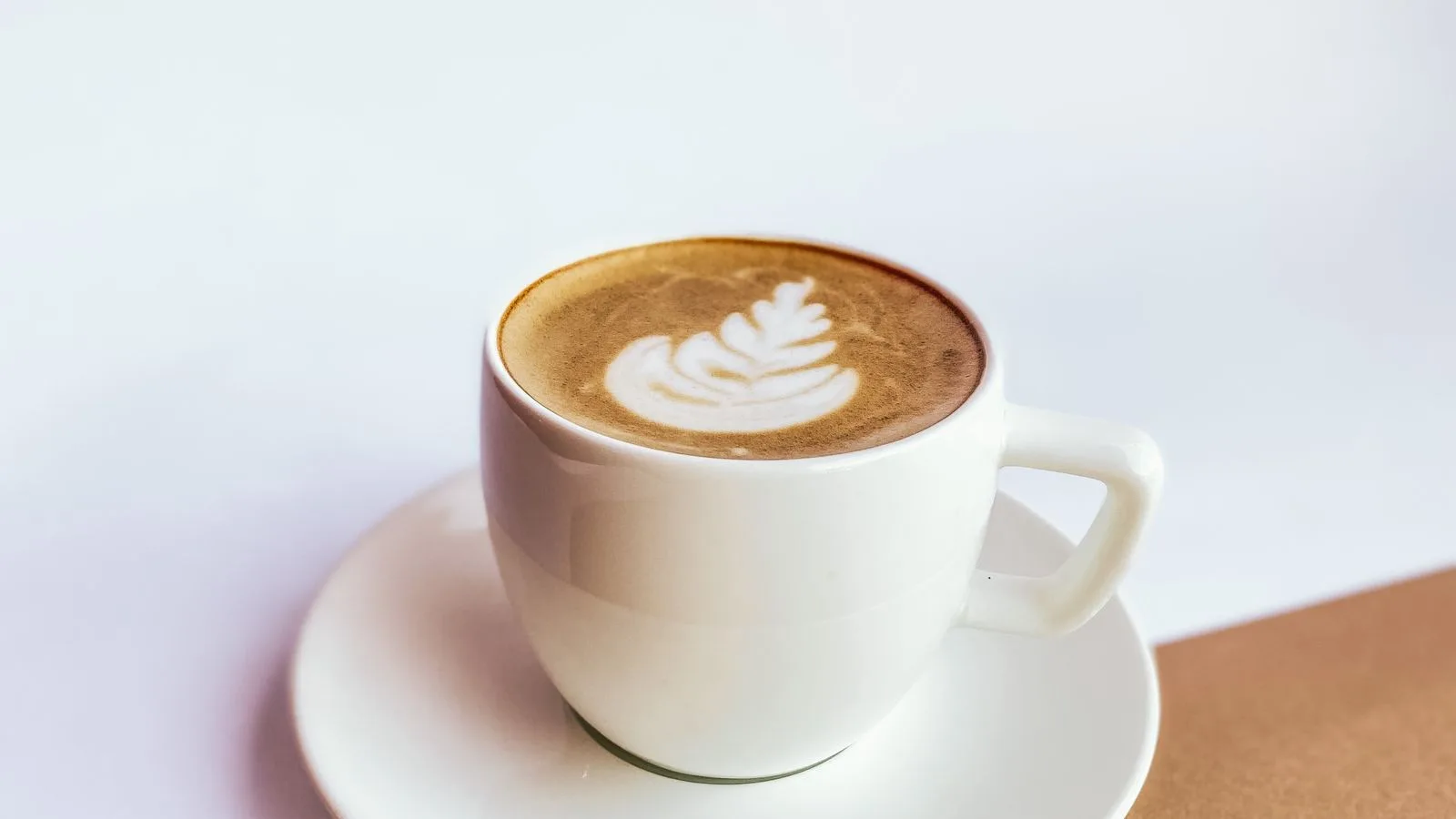
The pictured milk coffee has an unknown shot count, milk amount, cup volume, and drink name. Its fine milk surface illustrates texture. The photograph supplies no test result for this method.
Keep the method within your equipment's limits
Dairy milk contains a common allergen. If you use a plant drink, read its label and your frother or machine guidance. Breville gives a lower temperature example for non-dairy milk on its own page. That example does not establish the best limit for every product.
The flavor, foam, and amount that reaches the cup can change. Record the substitute and judge that drink on its own terms.
If your equipment cannot safely steam milk, use a suitable frother according to its instructions. The resulting texture may differ. Do not run a steam wand, electric frother, or hot pan outside its manual's fill, power, shutdown, or cooling rules just to match a photograph. Stop if a wand is blocked, a vessel overfills, or a hot part behaves unexpectedly, and use the manufacturer's cleaning or service instructions.
We read the linked La Marzocco Home and Breville methods on September 25, 2026. We did not physically test, own, prepare, taste, or measure the equipment or drink. The table is a source-based starting resource. The hypothetical cup shows how to record and adjust your own result.
Try one cup with the double shot and lightly textured milk, then save the amount you poured. On the next cup, adjust that amount only if the taste calls for it.
Hold the coffee recipe steady while you adjust how much milk reaches the cup.
Keep the coffee base repeatable
About Mara Ellis
Mara Ellis is Espresso Receipt’s fictional editorial voice. Warm, practical, and lightly witty, she turns coffee jargon into clear choices for your counter, budget, and next shot.
Read the profile and guides by Mara Ellis →Sources (3)
- The Beginner's Guide to Espresso DrinksLa Marzocco Home · Checked 2026-09-25(opens in a new tab)
- Flat WhiteBreville · Checked 2026-09-25(opens in a new tab)
- Building a House Menu with the Linea MiniLa Marzocco Home · Checked 2026-09-25(opens in a new tab)
See an old price or conflicting detail? Send a correction.
How we researched this
We use manufacturer, standards group, government, and authorized-retailer records when available. We label a hands-on result as an observed test only when we name the exact product and test it. A checked price shows what the seller listed on the check date. It can change after that date, and your delivered total may differ.
What the evidence labels mean
- Source checked
- A cited source stated this fact when Espresso Receipt checked it. This is not a physical product test.
- Estimated
- This is calculated from stated inputs and assumptions. It is not a measured result or a current quote.
- Observed physical test
- This is a hands-on result for the exact unit under a stated test method.
- We could not confirm this
- The available sources do not establish one reliable answer.