
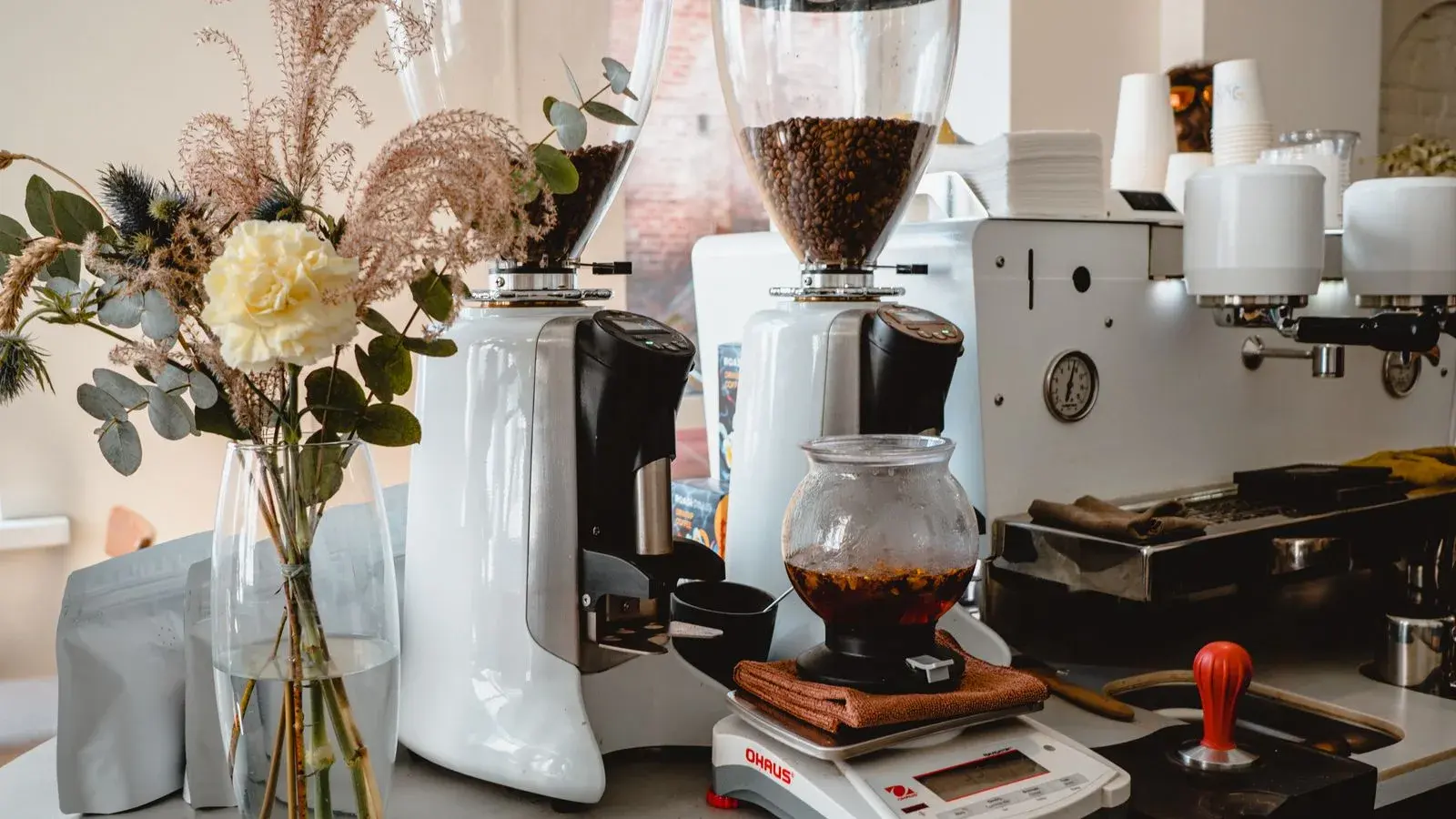
Flat burrs use two facing discs. Conical burrs use a cone inside an outer ring. For home espresso, choose an exact grinder by its espresso range, adjustment and daily routine. Shape alone does not establish a taste winner.
What the two shapes mean
Burrs are the shaped surfaces that break beans into smaller pieces. Niche Coffee's explanation describes two disc-shaped burrs for a flat set, and a cone inside a ring for a conical set. The gap between the surfaces changes as you adjust the grind.
| Check | Flat burrs | Conical burrs |
|---|---|---|
| Shape | Two facing discs | A cone inside an outer ring |
| Maker example | Baratza Forté AP: ceramic flat burrs | Original Baratza Encore ESP: conical burrs |
| What to verify next | Exact burr set, brew range and adjustment | Exact burr set, brew range and adjustment |
| What remains unproved here | Taste, retention, noise and speed | Taste, retention, noise and speed |
Baratza's Forté AP page identifies its ceramic flat burrs. The original Encore ESP manual identifies its cone and ring burrs. These are examples of each shape, rather than a recommendation to choose either model.
Check espresso range before burr diameter
A flat set can be designed for a different brewing task. Fellow's Ode Gen 2 specifications list 64 mm stainless-steel flat burrs and say the grinder is not intended for espresso. The original Encore ESP manual has a dedicated espresso adjustment range with its conical set.
That gives you a useful first check: find espresso in the exact model's supported brewing range. A larger diameter does not answer that question. Neither does a photo of the burrs.
Keep the full model name and installed burr set beside your notes. Encore ESP and Encore ESP Pro are different products. An optional replacement burr also needs its own fit and intended-use evidence.
Compare two exact grinders
Write the answers for each model on one sheet. Leave a blank when the maker or a reliable test does not answer a question.
- Confirm espresso support in the exact manual. If you also brew filter coffee, check that range separately.
- Check how you move between fine settings. Record fixed clicks or continuous adjustment, and the maker's instructions for changing the setting.
- Record how grinding stops and where grounds land. A timer, a scale-controlled stop and a manual switch are separate features from burr shape.
- Measure the space you can use. Allow for the hopper, collection cup and access described by the maker.
- Check replacement parts and the service route in your region. Confirm the exact burr part if future replacement matters to you.
For a claim such as lower retention, ask for a defined test of the exact grinder and burr set. Retention means coffee left inside after grinding. A shape label supplies no measured grams. Apply the same check to noise, speed and taste claims.
Use the espresso grinder capability guide to check the complete specification. When both models fit your task, compare their daily steps and total cost with the existing grinder shortlist. You can choose a routine without declaring a universal winner.
Try this with the grinder you have
If your current grinder supports espresso, try one controlled recipe change before replacing it. Use a dose that fits your basket and record the finished drink weight. Keep the coffee, dose and drink weight fixed for the next shot.
For the original Encore ESP, Baratza's manual says to run the grinder, or empty it of beans, before moving finer. Follow that exact instruction; another model may use a different procedure. Never put fingers inside a powered grinder.
Move one setting finer if you want to compare that change. Pull the next shot using your machine's normal controls and taste it. Record the setting, drink weight, time and one taste note. Stop the trial if flow stops or your machine shows a fault; follow its manual rather than forcing another shot.
This is a reader trial, with no predicted result. It can help you decide whether a recipe adjustment solves your problem. Use the dial-in procedure for the next adjustment.
Confirm espresso range, fine adjustment and daily controls for the exact model.
Check the complete grinder specification
About Mara Ellis
Warm, practical, and lightly witty, Mara turns coffee jargon into clear choices for your counter, budget, and next shot.
Read the profile and guides by Mara Ellis →Sources (4)
- Conical versus flat geometryNiche Coffee · Checked October 13, 2026(opens in a new tab)
- Forté AP U.S. product pageBaratza · Checked October 13, 2026(opens in a new tab)
- Original Encore ESP January 2023 v1.0 manualBaratza · Checked October 13, 2026(opens in a new tab)
- Ode Gen 2 U.S. specificationsFellow · Checked October 13, 2026(opens in a new tab)
See an old price or conflicting detail? Send a correction.
How we researched this
We read maker descriptions and the original Encore ESP manual, then separated burr shape from supported brew range and daily controls. The model-check worksheet is our editorial decision aid. The shot trial has not been performed.
We have no physical testing, ownership, taste tests or performance measurement for this comparison. We cannot confirm a winner for taste, retention, noise, heat, speed or durability. Maker descriptions establish published features; exact fit, current offers and results in your kitchen still need their own checks.
What the evidence labels mean
- Source checked
- A cited source stated this fact when Espresso Receipt checked it. This is not a physical product test.
- Estimated
- This is calculated from stated inputs and assumptions. It is not a measured result or a current quote.
- Observed physical test
- This is a hands-on result for the exact unit under a stated test method.
- We could not confirm this
- The available sources do not establish one reliable answer.