
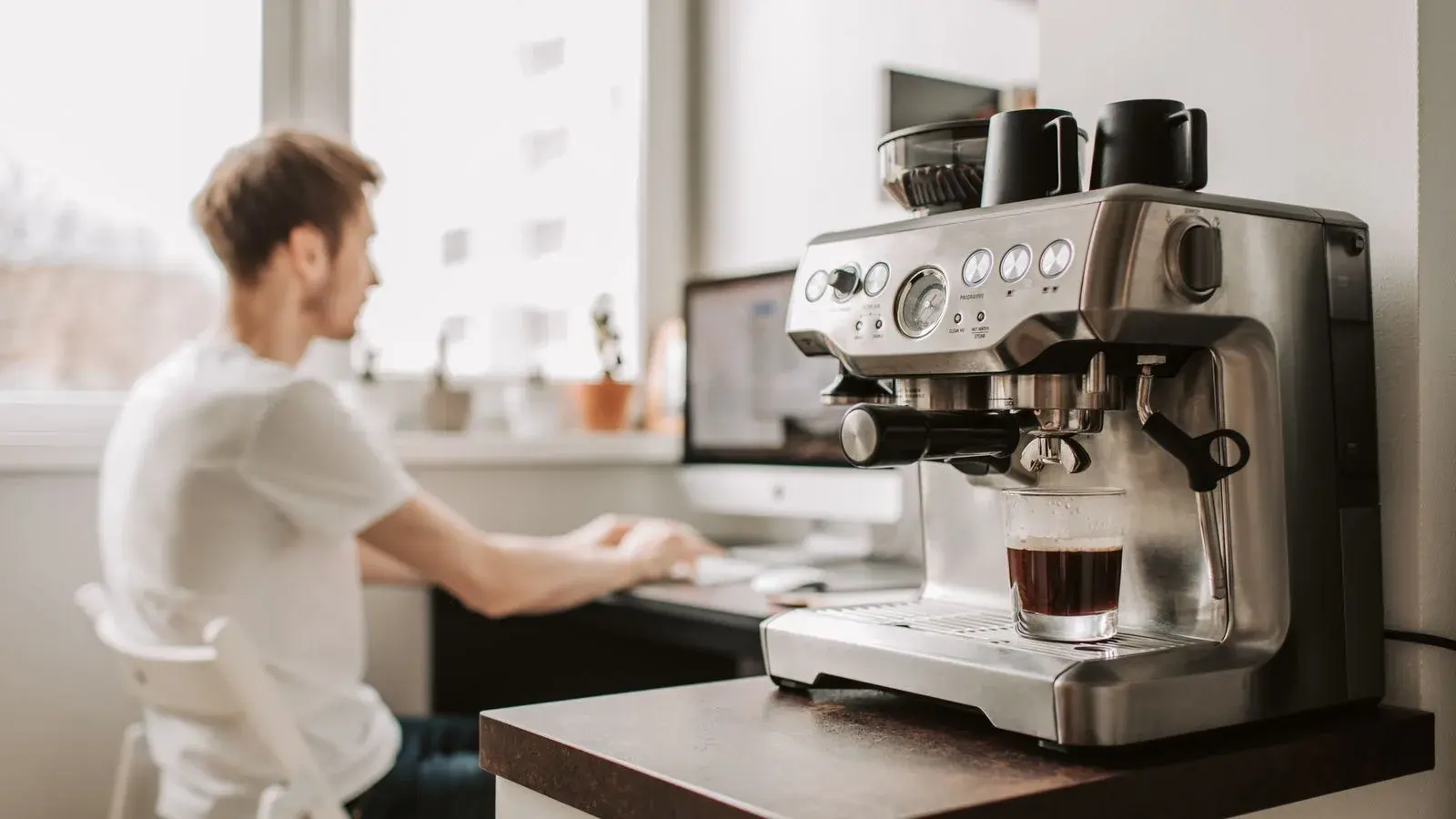
Choose an espresso machine with a grinder
Choose by the morning routine you want to repeat. Pick the $599.99 Ninja Luxe Café ES601 for the lowest checked one-box price, weight-based dosing, automatic milk, and the broadest drink range. Its published dimensions conflict, so measure the exact machine before you plan on a tight cabinet.
Pick the $699.95 Arte Evo EC9250M / SKU 0132126162 for a manual routine and cold-brew mode. Confirm its grinder settings and dimensions first, because the current page is internally inconsistent. The $799.95 Barista Express Impress suits assisted dosing and tamping (pressing the coffee flat in the basket) with manual milk.
The $849.95 Barista Pro suits a faster digital routine with manual milk. The $1,499.95 Touch Impress makes sense when touch guidance and automatic milk justify the higher price for you.
Pick the $699.95 Barista Express when its 54mm fit and pressure feedback suit your counter, and measure the exact unit, since its current dimension records conflict. Go with a separate machine and grinder when independent repair and upgrades matter more than one-box convenience.
These U.S. prices were checked September 16, 2026. Confirm the exact stock-keeping unit (SKU), delivered price, and operating fit when you order.
A portafilter is the handled part that holds the coffee basket. A stepless grinder adjusts through a smooth range with no fixed clicks. Basket sizes 51mm, 54mm, and 58mm determine which tools fit.
ThermoJet and thermocoil are heating systems, and PID manages temperature. Volumetric controls run preset shot amounts. Pressure feedback shows resistance during a shot.
Current machines with built-in grinders
Each machine below puts an espresso machine and a grinder in one box. “Guidance” means the published help with the routine, and you'll still use some technique.
| Machine | Checked price | Grinder record | Milk routine | Width × depth × height | Main downside |
|---|---|---|---|---|---|
| De’Longhi La Specialista Arte Evo EC9250M / SKU 0132126162 | $699.95 | Integrated conical; setting count not confirmed (current page lists 15 and 8) | Manual | Not confirmed for the current EC9250M | Manual milk; exact setting count and dimensions not confirmed |
| Ninja Luxe Café ES601 | $599.99 | Integrated conical; 25 settings; weight dosing | Automatic hot or cold milk | Conflicted: 12.99 × 13.39 × 14.57 vs 15.75 × 15.24 × 20.51 in | More assistance and drink modes; fit not confirmed |
| Breville Barista Express | $699.95 | Integrated conical; exact setting count not confirmed | Manual | Conflicted: 12.5 × 13.8 × 15.9 vs 15.9 × 13.1 × 12.4 in | Sale ended; fit not confirmed and grinder remains attached |
| Breville Barista Express Impress | $799.95 | Integrated conical; 25 settings | Manual | Conflicted: current and earlier U.S. records differ | Assisted dosing and tamping; attached grinder |
| Breville Barista Pro | $849.95 | Integrated Baratza European conical; 30 settings | Manual | 13.5 × 13.9 × 13.5 in | ThermoJet and digital guidance; higher price |
| Breville Barista Touch Impress | $1,499.95 | Integrated Baratza European conical; 30 settings | Automatic or manual | Conflicted: current and earlier U.S. records differ | Touch guidance and milk assistance; premium cost |
The prices spread too wide for one universal winner. The $599.99 Ninja competes with entry separate setups and adds more guidance. The $1,499.95 Touch Impress competes on assistance. Skip past those jobs, and a lower price can look like better value, or more automation like better coffee.
Lower-cost one-box choices
The $599.99 Ninja is now the lowest checked one-box path. At the July 22 check, the Barista Express and Arte Evo both showed $499.95 sale prices. By September 7, both records were $699.95.
Each comes to an estimated $789.95 startup total after Espresso Receipt’s $90 required-item allowance. The Ninja comes to an estimated $689.99.
The espresso setup calculator rebuilds these figures from current prices. The allowance covers a planning range for a scale, basic water and cleaning needs, and setup items. It leaves out tax, shipping, beans, milk, optional accessories, and repairs.
The Breville Barista Express is the same machine at the higher price. It has a 54mm fit, thermocoil with PID, manual milk, volumetric shot controls, and an integrated conical grinder. Its analog pressure feedback can help you watch the shot.
The catalog also keeps a variant warning on published dimensions and wattage. Match the exact U.S. SKU first whenever you shop for accessories or plan a circuit.
The De’Longhi La Specialista Arte Evo EC9250M / SKU 0132126162 has a 51mm basket, three infusion-temperature presets, manual milk, and a cold-brew mode in the current record. Its current page lists both 15 and eight grinder settings, so the setting count is not confirmed. Its exact dimensions are also not confirmed: the page lists 14.4x11.2x15.9 without saying which number is width, depth, or height. Don't call this model narrow, or compare its adjustment range with other integrated records, until the current unit is confirmed.
Choose between these two by basket system, controls, counter space, and adjustment expectations. Their checked prices are equal, so price won't separate them.
Best assistance without a touch screen
The Ninja Luxe Café ES601 and Barista Express Impress each take over a different part of the manual routine.
Ninja publishes weight-based dosing, 25 grinder settings, automatic hot or cold milk with four presets, and espresso, coffee, and cold-brew modes. That's the broadest drink routine in this price band. Ninja also publishes two conflicting dimension sets, including heights of 14.57 and 20.51 inches, so the machine cannot be called the largest or cleared beneath a cabinet from the current record. The checked record gives no portafilter diameter or named heater design, so we could not confirm those fields either.
The Barista Express Impress stays closer to a conventional manual espresso routine. Breville publishes a 54mm portafilter, 25-setting conical grinder, assisted dose correction, and assisted tamping. You steam the milk yourself. Its current and earlier U.S. dimension records conflict, so don't compare its size with the conflicted Ninja record until you've measured the exact unit.
Choose Ninja when drink range, weight-based guidance, and automatic milk can reduce meaningful daily work. Choose the Express Impress when help with puck preparation (dosing and tamping the coffee) matters and you still want manual milk and a conventional 54mm fit.
Best faster-interface integrated path
The $849.95 Breville Barista Pro pairs a ThermoJet heating system and digital interface with manual milk, a 54mm portafilter, and an integrated Baratza European conical burr grinder (burrs are its cutting parts) with 30 settings. Breville states a three-second heat-up. Espresso Receipt records that as a manufacturer claim. We have no timed result, and the claim covers heat-up only, so plan on more than three seconds for the portafilter, cup, and whole routine.
Next to the Barista Express at its restored $699.95 list, the Pro offers a different way of working: a quicker published startup system, digital feedback, and more clearly documented grind settings. We make no taste claim for either. The Express dimensions conflict, so we don't say either machine is shorter or wider.
At checked prices, the Pro routine costs $150 more. While the Express sale ran, the same routine cost $350 more.
The Pro makes sense when its interface and quicker published startup solve a repeated morning constraint. It's harder to justify when you mainly want a grinder upgrade, because the added money stays tied to a built-in grinder.
When touch and automatic milk justify the premium
The Barista Touch Impress adds a touch-led interface, automatic or manual milk, assisted puck preparation, 30 grinder settings, and the same 54mm accessory system used across this Breville group. At the current $1,499.95 price, you're paying for assistance.
That assistance can matter in a shared household. You can choose a drink, follow prompts, and make fewer decisions on the way to a repeatable routine. Automatic milk can reduce hands-on steaming technique. The product record doesn't show that the cup tastes better than one from a properly used lower-cost machine.
At this price, compare the Touch Impress with a separate machine and grinder as well as with cheaper machines that include a grinder. A separate $1,500 budget can buy independent components and keep a clearer upgrade path. The Touch Impress earns its price only when guided prompts and automatic milk are what you want.
What a separate setup buys instead
A separate setup starts from the same budget and keeps each appliance independent. The $299.95 Breville Bambino can pair with the $199.95 Baratza Encore ESP, $229 DF54, $399.95 Sette 270, or $549 Eureka Mignon Specialità. Those grinders stand for, in order, numbered espresso ranges, stepless single dosing, macro-plus-micro adjustment, and timed hopper routines (a hopper is the bean container on top).
| Separate path | Hardware price | With $90 allowance | Combined fit status | Grinder routine |
|---|---|---|---|---|
| Bambino + Encore ESP | $499.90 | $589.90 | Not confirmed; current Bambino dimension sources conflict | Hopper; 20-setting espresso range |
| Bambino + DF54 | $528.95 | $618.95 | Not confirmed; current Bambino dimension sources conflict | Stepless single dose |
| Bambino + Sette 270 | $699.90 | $789.90 | Not confirmed; current Bambino dimension sources conflict | Hopper; macro plus stepless micro |
| Bambino + Specialità | $848.95 | $938.95 | Not confirmed; current Bambino dimension sources conflict | Timed hopper; stepless micrometric |
We've dropped the earlier numeric planning-width estimates. Current U.S. Bambino sources conflict on dimensions, so we don't rank these pairings by width. Measure the exact machine and grinder while stored, used, refilled, and cleaned. Portafilter movement, power cords, bean loading, water access, and your working surface extend beyond the stored size.
Separate equipment creates more combinations, and it may or may not take more width than a given machine with a built-in grinder. A Bambino pairing is still a separate-components option, but its combined fit stays unconfirmed until the machine dimensions are resolved. The Barista Express sources also conflict, so neither published width can settle which setup is narrower.
Counter space is more than body width
Integrated machines often take up less side-to-side room because the grinder sits above or inside the machine body. That can shift the space problem upward, since you need room to open a hopper, pour beans, remove a water tank, and open cabinets. Ninja publishes both 14.57- and 20.51-inch heights, so neither value clears a cabinet. Measure the exact ES601.
Depth matters once you're making a drink. The portafilter handle sticks out from the group, a scale and cup sit on the drip tray, and a milk pitcher needs somewhere to land. Water reservoirs may lift out from the top or slide out the back, and published dimensions rarely describe every position during use.
Measure it like a new microwave, in three states: stored, making a drink, and refilling or cleaning. Mark the available width, counter depth, cabinet height, outlet position, and where the grinder lid or water tank travels. If the catalog does not confirm a dimension, measure the exact retail unit or get a current manufacturer answer. Use the exact U.S. value.
Grinder adjustment is not just a setting count
Setting count is useful, and it describes only part of a grinder. Step spacing, burr geometry, calibration, motor behavior, retention (old grounds left inside), dose transfer, and coffee condition also affect the routine. Two grinders with 30 settings can space those positions differently.
A good grinder for your counter lets a small adjustment move shot flow with no forced dose change. The Arte Evo EC9250M setting count is not confirmed because its current page lists 15 and eight. The 25- or 30-setting records can't be compared with one confirmed Arte count until the current controls are verified.
A separate stepless grinder moves continuously within its adjustment system. That can make fine correction easier, though returning to an exact old position may require a written note. A numbered grinder can be easier to describe and repeat. Choose the adjustment routine that suits you.
Built-in grinders limit later upgrades
A built-in grinder can't be swapped out on its own, because an integrated appliance contains two important systems. If you still like the machine but the grinder no longer suits your coffee or dosing style, adding a separate grinder leaves the built-in one unused. If either part needs service, the combined appliance may leave the entire coffee station unavailable.
A separate setup keeps that decision small. The machine can stay while the grinder changes from hopper to single dose, or the grinder can stay while the machine changes heating design. That flexibility has value even if no upgrade happens in the first year.
A built-in grinder can still be the right call. One manufacturer, one visual system, fewer purchases, and guided compatibility can outweigh future flexibility. Ask yourself whether you value one contained unit now or independent options later.
Match the milk routine before the grinder
The grinder layout leaves the milk routine to the machine. The Barista Express, Arte Evo, Express Impress, and Barista Pro use manual milk, while Ninja and Touch Impress provide automatic assistance. That difference can shape your morning more than the dosing system.
For straight espresso, automatic milk adds nothing to the cup. For one practiced latte, manual steaming may be enjoyable and fast enough. For two drinks before work, hands-free milk can free up your attention. If you want latte-art control, manual steaming may be the point.
Count the drinks in your busiest ten minutes and note who makes them. Then decide whether milk technique is a skill you want, a chore you'll accept, or a hard no. Let grinder integration break the tie only after that.
Decide with four questions
First, decide whether you want to learn and control milk by hand. That separates the automatic Ninja and Touch Impress paths from the manual field.
Second, measure the complete space needed to use the setup. Integrated can take less or more room than you expect, and so can separate.
Third, decide whether a grinder upgrade is plausible. If trying different grinders, burrs, or dosing styles is part of the hobby you want, keep the grinder separate. If a contained routine is the goal, one built-in grinder may be a feature.
Fourth, compare the complete checked total. Add the machine, the grinder if it's separate, required setup items, tax, shipping, water needs, and the first coffee supply. A sale-price integrated machine may be the lower initial path, and a separate setup may preserve more long-term options.
These records show prices and measurements. They are not matched to your kitchen. Use Find my setup to check your budget and counter space.
Find my setup →Products mentioned
Open a product to see its exact source, checked date, known uncertainty, dimensions, and main downside.
Compare 4 of these machines side by side →Compare these 4 grinders side by side →
Common questions
Are built-in espresso grinders good enough?
Some can support a practical daily routine. Check flexibility too: compare adjustment range, retention, dosing routine, and whether you want to upgrade independently.
Does an integrated machine take less space?
Not always. Compare the exact machine with the complete separate setup. Measure the height, width, depth, and room needed to use the hopper, tank, and portafilter.
Which is cheaper?
That depends on current prices and which separate grinder you pick. Compare the complete setup, grinder included.

About Mara Ellis
Warm, practical, and lightly witty, Mara turns coffee jargon into clear choices for your counter, budget, and next shot.
Read the profile and guides by Mara Ellis →Sources (14)
- Espresso Receipt methodologyEspresso Receipt · Check date not recorded
- Encore ESP product pageBaratza · Check date not recorded(opens in a new tab)
- Bambino product pageBreville · Checked September 16, 2026(opens in a new tab)
- Barista Express product pageBreville · Checked October 20, 2026(opens in a new tab)
- Barista Pro product pageBreville · Checked October 20, 2026(opens in a new tab)
- Barista Touch Impress product pageBreville · Checked October 20, 2026(opens in a new tab)
- Barista Express Impress product pageBreville · Checked October 20, 2026(opens in a new tab)
- La Specialista Arte Evo EC9250M product pageDe’Longhi · Checked September 16, 2026(opens in a new tab)
- Luxe Café Premier Series ES601 product pageNinja · Checked October 20, 2026(opens in a new tab)
- Encore ESP product pageBaratza · Checked October 20, 2026(opens in a new tab)
- Sette 270 product pageBaratza · Checked October 20, 2026(opens in a new tab)
- Mignon Specialità product pageEureka · Checked September 7, 2026(opens in a new tab)
- Mignon Specialità US listingWhole Latte Love · Checked October 20, 2026(opens in a new tab)
- DF54 v1.5 product pageMiiCoffee · Checked October 20, 2026(opens in a new tab)
See an old price or conflicting detail? Send a correction.
How we researched this
We use manufacturer, standards group, government, and authorized-retailer records when available. We label a hands-on result as an observed test only when we name the exact product and test it. A checked price shows what the seller listed on the check date. It can change after that date, and your delivered total may differ.
What the evidence labels mean
- Source checked
- A cited source stated this fact when Espresso Receipt checked it. This is not a physical product test.
- Estimated
- This is calculated from stated inputs and assumptions. It is not a measured result or a current quote.
- Observed physical test
- This is a hands-on result for the exact unit under a stated test method.
- We could not confirm this
- The available sources do not establish one reliable answer.