
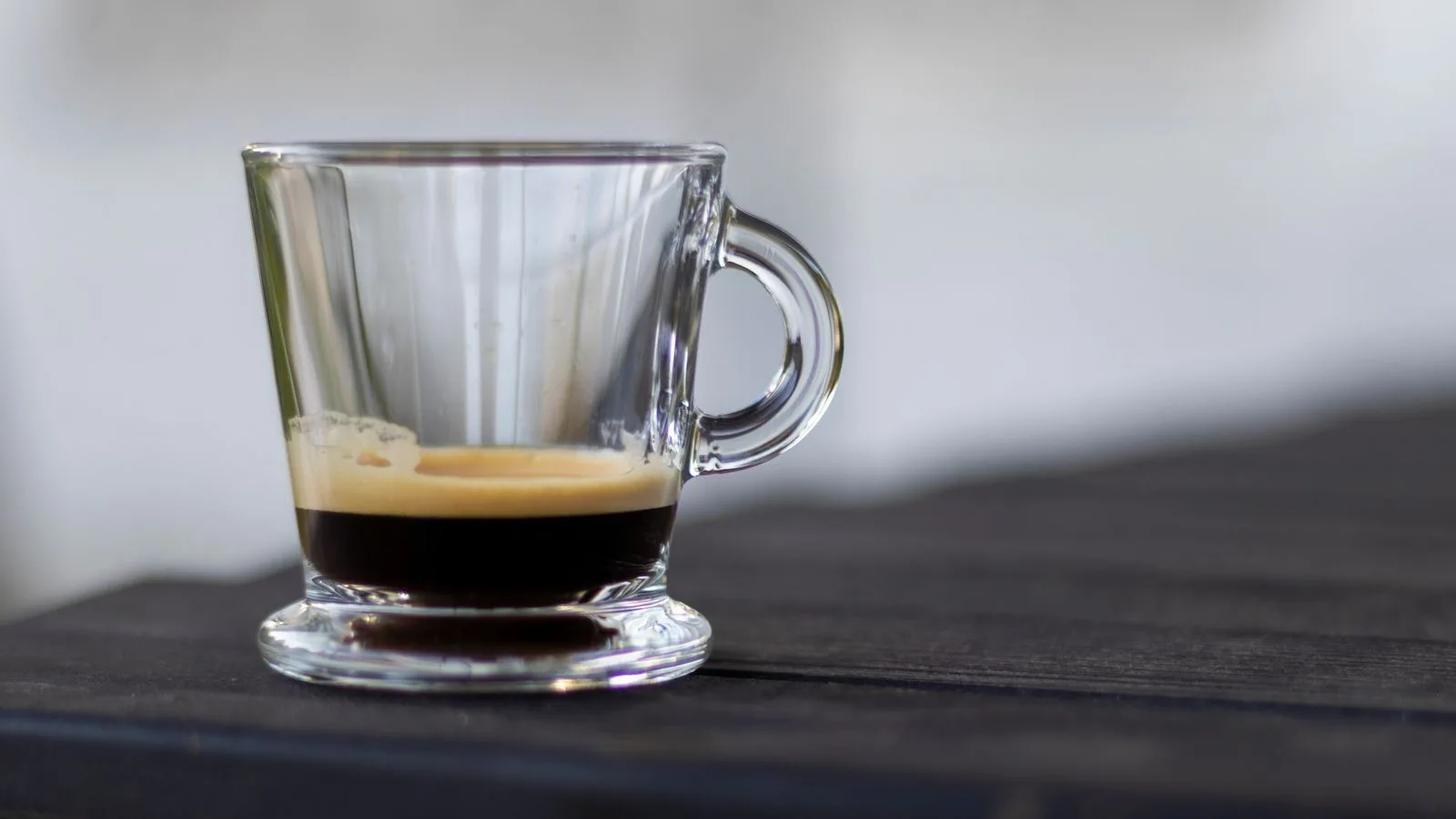
These are reference entries, not a measurement of every shot. The USDA numbers describe a generic food record; the Starbucks number describes one named menu item. Your café may pour a different amount or use a different recipe. Start with its nutrition listing when it has one, and check the size and shot count before comparing drinks.
Check the serving before the number
An ounce in a coffee recipe can mean volume or weight. USDA's espresso food record gives energy per 100 grams and lists a 1 fluid ounce portion as 30 grams. It also lists an espresso cup of 2 fluid ounces as 60 grams. The record reports 9 kilocalories per 100 grams. Multiply that rate by each portion's weight, then round to a whole calorie: 9 × 30 ÷ 100 is 2.7, or about 3 calories; 9 × 60 ÷ 100 is 5.4, or about 5 calories. The USDA portion method uses the same per-100-gram calculation. A kilocalorie is the unit called a calorie on a food label.
Those figures are low, but they are not zero. They also do not make every small cup a 3-calorie cup. If the café's shot is smaller or larger than the USDA portion, its total can differ. A cup's capacity is not the volume of espresso poured into it. When you make espresso at home, note the liquid you actually serve; our guide to espresso shot ounces explains why a single and a double do not have one universal volume.
Starbucks offers a useful second reference. Its Espresso nutrition entry calls the selected doppio 1.5 fluid ounces and lists 10 calories, zero grams of sugar, and zero grams of fat. The selected Espresso menu entry shows two shots. The Starbucks number is for that menu item, not a conversion factor for all espresso. The USDA's 2-fluid-ounce generic cup and Starbucks' smaller doppio also come from different records and preparation choices. Do not use the difference between them as proof that one coffee or café has a measured extra nutrient.
| Reference serving | What the source reports | Calories to use | What it covers |
|---|---|---|---|
| USDA plain espresso, 1 fl oz (30 g) | 9 kcal per 100 g | About 3, calculated | Plain coffee only |
| USDA plain espresso, 2 fl oz (60 g) | 9 kcal per 100 g | About 5, calculated | Plain coffee only |
| Starbucks Espresso, doppio, 1.5 fl oz | Two shots in the selected menu item | 10, listed | That plain Starbucks order |
Use the first two rows when a generic estimate is enough and you know the amount. Use the last row for the named Starbucks drink. For another café, look for its own current nutrition listing. The table cannot tell you how much milk or sweetener is in a drink whose recipe you do not know.
Count what goes into the cup
The drink name alone can hide most of the calories. An Americano adds water to espresso; the water increases volume without adding calories. Milk changes the total, and its contribution depends on the amount and the exact dairy or plant product used. Sugar, syrup, sauces, cream, and toppings each need their own amount. A small-looking drink can carry several additions, while a larger black coffee may have very few calories.
Start with the plain coffee, then write down each addition. Read the Nutrition Facts label for the actual milk or packaged ingredient, including its stated serving size. A carton may list calories per cup while you pour only a small fraction of a cup. Scale the number to the amount you use. For a café drink, the posted nutrition for the exact size and selected ingredients is better than a home estimate, especially when you do not know how much milk the barista uses.
The U.S. Food and Drug Administration states that traditional sugar has 4 calories per gram. If you weigh 4 grams of table sugar, it adds about 16 calories. A teaspoon is a kitchen measure, but a heaped and a level spoon do not weigh the same. When the number matters, weigh the sugar or use a packet's label. For flavored syrups, use that product's label; a pump is not a fixed volume across brands or dispensers.
For milk, write down the product and amount. Whole dairy milk, 2% milk, and plant drinks have different labels, and some plant drinks are sweetened. A menu word such as “oat” does not provide the calories for a specific pour. If you want to compare two options, keep the cup size and espresso count the same, then compare each milk's listed calories for the amount the recipe uses. If the café does not publish the milk amount or adjusted nutrition, the exact difference remains unknown. You can still choose a smaller drink or ask for less of an addition without pretending you know its exact calorie total.
Try this with your next order
Here is a hypothetical order with enough information to calculate. Use Starbucks' listed plain two-shot doppio as the base: 10 calories. Add 4 grams of traditional table sugar. The FDA's 4-calorie-per-gram value makes that 4 × 4 = 16 calories. The two-shot drink with that measured sugar is about 26 calories before any milk. This is arithmetic from the published base and the stated sugar amount; it is not a tested Starbucks customization or a café nutrition claim.
Now suppose you add 60 milliliters of a milk whose actual carton says 120 calories per 240-milliliter serving. Those label numbers are hypothetical, so check your carton before using them. One quarter of that serving supplies 120 × 60 ÷ 240 = 30 calories. The example drink would be about 56 calories: 10 from the named plain espresso, 16 from 4 grams of sugar, and 30 from the assumed milk. If you use 120 milliliters of that same milk, the milk portion doubles to 60 calories and the example drink becomes about 86 calories. The amount of milk can move the total much more than a change between the two plain-espresso references.
You can do this calculation with any labeled addition. Write the label's calories and serving amount, then multiply by the fraction you used. Keep the units matched: 60 milliliters divided by a 240-milliliter serving gives one quarter. For a syrup label stated per tablespoon, measure tablespoons. For sugar by weight, use grams. Round the final total as an estimate, because the coffee portion and your pour may not exactly match a database entry or the marked line on a cup.
There is a quick experiment here if you make the drink yourself. Keep the coffee and cup size the same for two drinks. Measure the milk in the first, then use half as much of that same product in the second, without changing the sugar. The label calculation shows how the estimated calories change. Taste both before deciding which amount you prefer. This comparison has not been prepared or taste-tested for this article; it is a way to make your own measured choice.
Read a café listing carefully
A chain's nutrition page describes an order with particular defaults. Before using the calories, check the drink name, size, hot or iced choice, milk, shot count, and flavor additions. The Starbucks Caffè Latte page, for example, is a finished milk drink rather than the plain Espresso menu item. Its displayed nutrition can change with the selected size and options. Reading its calorie number as “espresso calories” would assign the milk and any other ingredients to the shot.
If the online menu lets you customize a drink, confirm whether the nutrition number updates with your choices. When it does not, treat the displayed number as the default recipe. Ask the café for its exact ingredient or nutrition information if you need an accurate total. An unlisted splash of milk cannot be recovered from the finished cup's appearance, and a foam layer does not show how much milk was used. For an allergy or other medical need, use the seller's current ingredient and allergen information instead of this calorie estimate.
Shot count matters too. A “double” names two espresso shots, but the finished volume can vary. Our caffeine guide explains why counting shots helps with caffeine; it is a separate question from counting calories in milk and sweeteners. More espresso adds the coffee's small calorie contribution. It does not tell you how much milk, syrup, or cream a drink contains. A three-shot latte and a two-shot latte can have similar totals if their other ingredients differ, so compare the complete orders when calories are the reason for your choice.
At home, the simplest record is a short recipe note: espresso amount, milk product and amount, sugar or syrup amount, and each label used. Save that note if you make the drink often. Change one ingredient at a time when you want to adjust it, then taste the result. The next calculation will be based on your actual cup rather than on a drink name.
What the estimate cannot tell you
Calorie totals do not describe caffeine, nutrients, allergens, or whether a drink fits a person's medical needs. A plain espresso is low in calories, but that fact does not make unlimited shots appropriate. For caffeine, read the separate espresso caffeine reference and use medical advice that fits your situation. This article does not prescribe a diet or a caffeine limit.
We did not test, own, taste, or measure the espresso or finished drinks discussed here. The USDA and menu figures are published reference values. The sugar and milk examples are labeled calculations, with hypothetical milk inputs. A real drink's ingredients and serving size can differ. When you have a current label or exact café listing, use it for the drink in front of you.
Serving size changes the reference calorie estimate, so compare the poured amount before counting additions.
Check how much espresso you actually serveCommon questions

About Mara Ellis
Mara Ellis is Espresso Receipt’s fictional editorial voice. Warm, practical, and lightly witty, she turns coffee jargon into clear choices for your counter, budget, and next shot.
Read the profile and guides by Mara Ellis →Sources (7)
- FoodData Central: Coffee, espresso (FNDDS 2710378)U.S. Department of Agriculture · Checked 2026-09-23(opens in a new tab)
- FoodData Central Foundation Foods documentationU.S. Department of Agriculture · Checked 2026-09-23(opens in a new tab)
- Espresso nutrition, selected doppioStarbucks · Checked 2026-09-23(opens in a new tab)
- Espresso menu, selected doppioStarbucks · Checked 2026-09-23(opens in a new tab)
- Serving size on the Nutrition Facts labelU.S. Food and Drug Administration · Checked 2026-09-23(opens in a new tab)
- Traditional sugar energyU.S. Food and Drug Administration · Checked 2026-09-23(opens in a new tab)
- Caffè Latte menuStarbucks · Checked 2026-09-23(opens in a new tab)
See an old price or conflicting detail? Send a correction.
How we researched this
We use manufacturer, standards group, government, and authorized-retailer records when available. We label a hands-on result as an observed test only when we name the exact product and test it. A checked price shows what the seller listed on the check date. It can change after that date, and your delivered total may differ.
What the evidence labels mean
- Source checked
- A cited source stated this fact when Espresso Receipt checked it. This is not a physical product test.
- Estimated
- This is calculated from stated inputs and assumptions. It is not a measured result or a current quote.
- Observed physical test
- This is a hands-on result for the exact unit under a stated test method.
- We could not confirm this
- The available sources do not establish one reliable answer.