
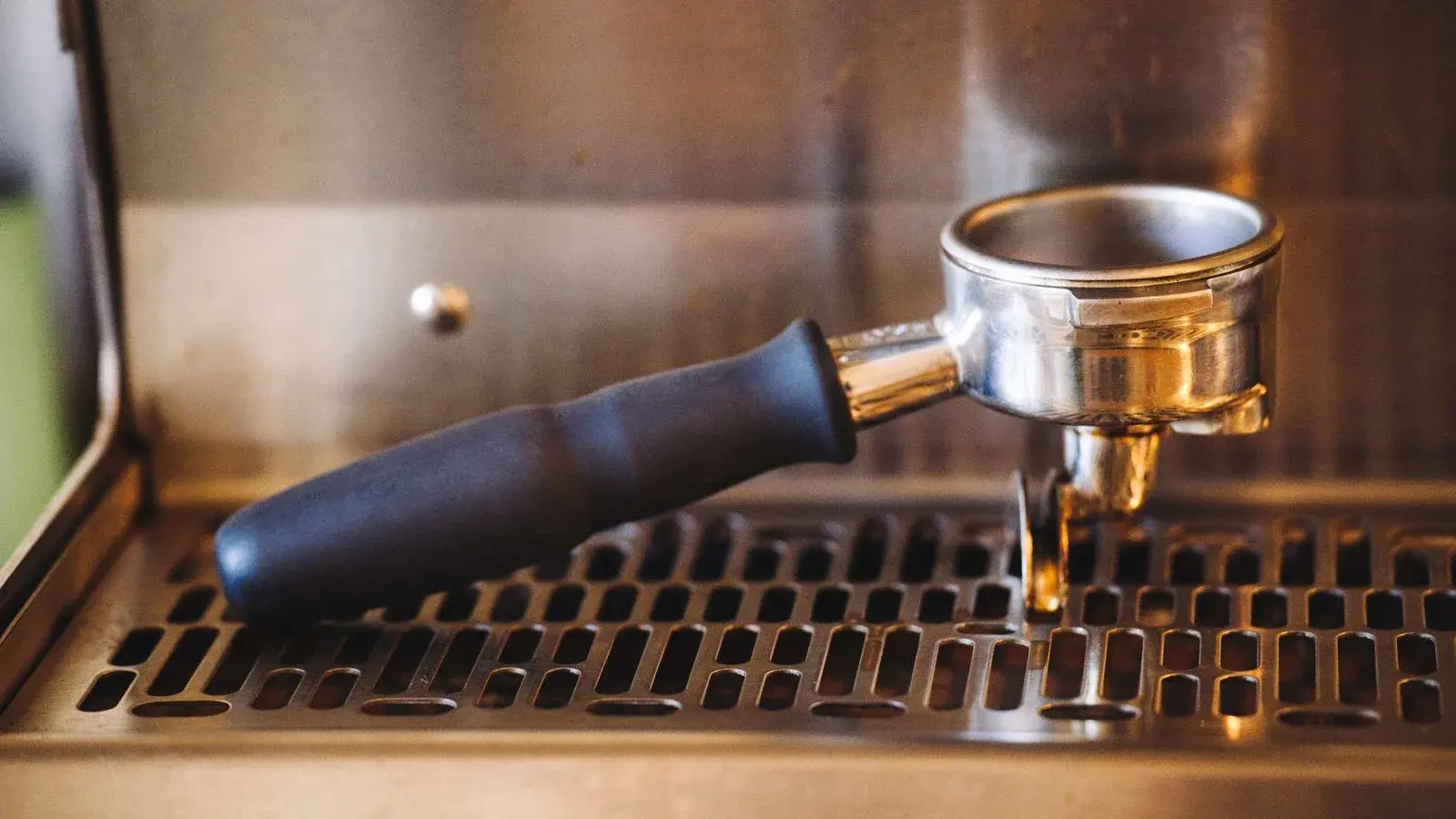
Pre-infusion is the first part of some espresso shots
Pre-infusion is a low-pressure wetting stage before a machine moves to full brewing pressure. Breville's Infuser BES840 manual describes it as a gradual pressure increase that expands the coffee bed before the higher-pressure part of extraction. Not every machine gives the same control, and some machines do not expose a pre-infusion setting at all.
If your shot has no adjustable pre-infusion, you can still make espresso. Start with a stable dose, target drink weight, and grind setting. The dial-in guide covers those controls.
Check what your machine can control
| Machine behavior | What to record |
|---|---|
| Automatic pre-infusion | The default time shown in the manual or display |
| Breville Infuser BES840 hold-to-pre-infuse control | How long the 1 CUP or 2 CUP button was held before release to full pressure |
| No listed control | The normal shot time from pump start |
For the BES840 manual-shot control:
- Press and hold 1 CUP or 2 CUP to begin low-pressure pre-infusion.
- Release the button to continue at full pressure.
- Press 1 CUP or 2 CUP again to stop at your target espresso amount.
Use the manual for your exact model and revision. Keep the portafilter locked during extraction and keep clear of hot parts.
The BES840 manual also shows a pressure gauge. Its needle sits in the pre-infusion zone at the start of extraction, then moves toward the full-pressure zone. The gauge gives you a way to see which part of the shot is underway; it does not tell you whether the coffee tastes good.
Use one stable shot recipe
Set a dose and target yield first. Record total shot time from pump start, including any pre-infusion. This article does not use first-drip time as a comparison value. Then change only the pre-infusion control on the next shot. Keep the grind and dose unchanged while you compare the flow.
For example, write down how long you held the BES840 cup button on the first shot. On the next shot, release it a little earlier while keeping the same dose, grind, and target drink weight. Record the new hold time and total shot time. Taste both cups. If the second is worse, return to the first hold time. This is a comparison to make at your counter, not a recommended number of seconds.
Do not read an increase in total shot time as proof of better extraction. The low-pressure stage is part of that total. Compare taste as well as flow; there is no single pre-infusion time for every setup. The coffee, machine, and basket can all change the result.
For the grinder adjustment that follows a flow change, use how to dial in espresso. Light-roast espresso gives a controlled example for a lighter coffee.
Compare the same endpoint, not the same clock reading
Make the drink weight your endpoint for both shots. If the first shot ends at one weight and the second ends at another, you have tested two changes: the pre-infusion hold and the amount of espresso in the cup. A scale under the cup makes that mistake easier to avoid. Write the total time beside the weight after the shot stops. On the BES840, press the cup button again to stop the manual shot at that endpoint, as its manual directs.
Here is an illustrative log, not a result from our counter. It shows what to record when you use the BES840's manual control. Choose a dose and yield that suit your basket and coffee; the times below do not set targets.
| Record | Shot A | Shot B |
|---|---|---|
| Coffee dose and espresso yield | Your same recorded dose and yield | The same dose and yield |
| Hold before release | 5 seconds | 3 seconds |
| Total time from pump start | 30 seconds | 28 seconds |
| Taste and flow note | Write what you actually observe | Write what changed |
The two-second change in total time does not show whether the cup improved. It partly reflects a shorter hold at low pressure. If B tastes better and its flow is steady, write down that setting for the next shot. If A tastes better, restore A's hold. If both taste alike, leave the control alone and work on the part of the recipe that still bothers you. This is a small test, not a hunt for a magic number.
Let the machine follow the same warm-up routine for both shots. Use the same coffee and basket, prepare the coffee bed the same way, and start the timer at the same event: pump start. If the second shot splashes or runs unevenly, note that before you judge the hold time. The BES840 pressure gauge shows which stage the machine is in, but its zone is not a taste score. Its needle can help you confirm that a hold began at low pressure and that release moved the shot onward.
Separate a pre-infusion question from a grind question
A shot that races to its target weight and tastes sharp may need a grind change. A slow, harsh shot may need a different grind in the other direction. The dial-in guide explains that decision. First return to the pre-infusion setting you recorded, then change the grind on a later shot. Moving both controls in the same comparison makes the cause unclear.
If your machine only has automatic pre-infusion, record it as part of the machine's shot cycle. You can still compare two shots at the same dose and yield while changing the grind. If your model has a menu setting rather than a hold button, read its manual before changing it. The BES840 sequence does not describe that menu. A machine with no listed control needs no improvised low-pressure routine.
Pre-infusion also cannot settle every uneven shot. Check the basket and coffee preparation when flow changes from one pull to the next even though the recipe stayed the same. Write down the visible symptom instead of assigning a cause from the gauge alone. Once dose, yield, and flow repeat well enough to compare, you can return to the hold test. That keeps one experiment small enough to read.
One more timing detail matters when you compare a recipe from another person. Some recipes start a timer when the pump starts; others start at the first drops in the cup. A pre-infusion hold makes those readings diverge. Our log always starts at pump start and includes the full hold. If a recipe says only “30 seconds” without naming its start point, use it as context instead of trying to match it exactly. Record the first-drop time separately if your machine shows it, but keep the same total-time definition for your own A and B shots. A consistent measurement tells you more about your change than a borrowed clock number.
Use the manual as the safety limit
Do not bypass model-specific controls or pressure limits. If a manual only describes an automatic shot, leave that setting in place and adjust the normal dial-in variables instead. The BES840 manual warns that the metal portafilter gets very hot and must stay locked in during brewing. Stop the shot with its cup button before you touch or remove it.
We checked the Breville BES840 manual on September 22, 2026. This is a source-based guide. We did not prepare or taste these shots.
Keep the dose and yield stable while you compare pre-infusion.
Set a repeatable shot recipeCommon questions
Does total shot time include pre-infusion?
For the comparisons in this guide, start the timer with the pump and include pre-infusion. Record the pre-infusion setting separately. Do not compare that total with a time measured only from the first drip.

About Mara Ellis
Warm, practical, and lightly witty, Mara turns coffee jargon into clear choices for your counter, budget, and next shot.
Read the profile and guides by Mara Ellis →Sources (1)
See an old price or conflicting detail? Send a correction.
How we researched this
We use manufacturer, standards group, government, and authorized-retailer records when available. We label a hands-on result as an observed test only when we name the exact product and test it. A checked price shows what the seller listed on the check date. It can change after that date, and your delivered total may differ.
What the evidence labels mean
- Source checked
- A cited source stated this fact when Espresso Receipt checked it. This is not a physical product test.
- Estimated
- This is calculated from stated inputs and assumptions. It is not a measured result or a current quote.
- Observed physical test
- This is a hands-on result for the exact unit under a stated test method.
- We could not confirm this
- The available sources do not establish one reliable answer.