
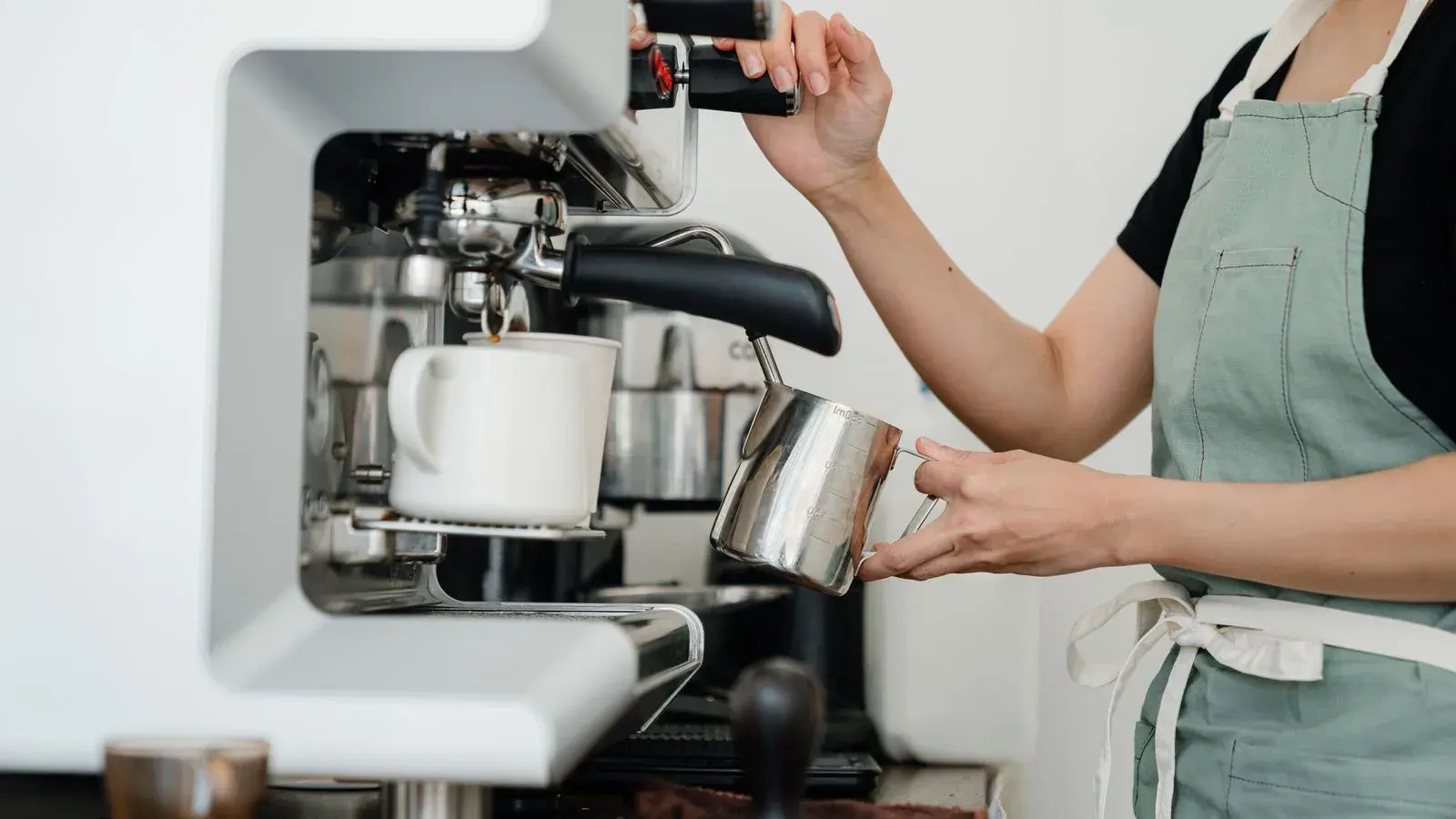
Wipe and purge after every milk drink
Wipe the steam wand after you texture milk, then briefly purge it as your machine manual directs. Milk left at the tip can block its holes and reduce steam flow. The procedure below follows the Breville Barista Express BES870 manual. Check your exact model before you use its controls or remove a tip.
Follow the BES870 daily routine
- Keep your hands clear of the hot tip. Wipe the wand with a damp cloth after steaming milk.
- Point the tip over the drip tray, away from people. Briefly turn the STEAM/HOT WATER dial to STEAM to clear milk left inside the wand.
- Return the dial to STANDBY. Check the tray and empty it when the machine's indicator calls for it.
The purge is brief; the manual does not give a universal number of seconds. A different machine may use a button or an automatic purge, so use its own sequence. Keep the cloth for wiping the outside of the wand. The BES870 manual uses its supplied tool for a blocked tip.
Clear a blocked BES870 tip
If one or more tip holes are blocked, first put the STEAM/HOT WATER dial in STANDBY. Press POWER to switch the machine off and let the wand cool. Then use the pin on the supplied cleaning tool to clear the hole. Do not touch the tip while it is hot.
If the blockage remains, the BES870 manual says to remove the tip with the spanner built into that cleaning tool. Soak the removed tip in hot water. Use the pin again to clear its holes, then reattach the tip. Follow the manual's removal and reattachment instructions. Do not force a tip off a machine whose manual does not say it is removable.
If you still have no steam, a blocked tip is only one possibility. The BES870 troubleshooting table also lists a machine that is still heating, an empty or loose water tank, and a machine that needs descaling. Check the indicator and tank against your exact manual. Stop if flow does not return after the approved cleaning steps or a part is damaged; contact the maker for help. Do not put a guessed cleaner or tool into the wand.
Decide which path fits the symptom
A dirty outside surface with normal steam flow calls for the daily wipe and purge. Weak flow from one or more tip holes calls for the blocked-tip sequence after the machine is off and cool. No steam at all can also mean the machine is still heating or the tank is empty or loose. Check those signs before you handle the tip. If the BES870 manual points to descaling, use its separate descaling process. Soaking a removed tip does not treat deposits elsewhere in the machine.
Record what you saw before cleaning: normal flow with exterior milk, uneven flow at the holes, or no steam. After the approved action, check the same symptom. If it remains, the record tells Breville support what you have already ruled out. Repeating the same hot, pressurized step without a new reason adds risk.
For example, suppose the BES870 tip holes look clear but the machine produces no steam. In this hypothetical case, cleaning the holes again has no identified purpose. Check the heat state and whether the water tank is filled and seated, as the troubleshooting table directs. If those checks pass and the manual indicates a descale alert, follow that separate procedure. Record each result. If the machine still has no steam, stop and give Breville the model and your check record.
Keep the parts and liquids in their places
Soak only the removed tip when the manual calls for it. Do not immerse the machine or pour hot water into the assembled wand. Use the supplied pin, not a larger needle or drill that could damage a hole. The manual does not direct you to put detergent or vinegar into the steam path. If you think a different product is needed, ask Breville which process applies to the exact model.
Confirm that cleaning solved the right problem
After you reattach a removable tip, check that it is secure using the manual's method. Resume normal machine operation only after reassembly. Point the wand into the drip tray for a brief model-approved purge and check the flow. If it is still weak, stop rather than adding milk to test it. The descaling guide explains why that job needs its own model-specific sequence.
On the next milk drink, record whether the wand textured milk as it normally does for your machine. One good purge after cleaning shows that flow returned at that moment. It does not prove the cause of a recurring blockage. If the same symptom comes back quickly, contact support with the exact model, the steps already tried, and the symptom you saw. That gives the next check a real starting point.
Once normal steam flow returns, make a cappuccino or make a latte. Wipe and purge again when you finish.
We checked the Breville BES870 manual on September 22, 2026. This is a source-based guide. We did not clean or test a steam wand.
Use the milk-texturing steps once normal steam flow is restored.
Make a cappuccino after cleaningCommon questions
What should I do if the steam tip stays blocked?
For the BES870, return the steam dial to STANDBY, switch off, and let the wand cool before using the supplied cleaning pin. Follow the exact manual for removal or soaking if it remains blocked.

About Mara Ellis
Warm, practical, and lightly witty, Mara turns coffee jargon into clear choices for your counter, budget, and next shot.
Read the profile and guides by Mara Ellis →Sources (1)
See an old price or conflicting detail? Send a correction.
How we researched this
We use manufacturer, standards group, government, and authorized-retailer records when available. We label a hands-on result as an observed test only when we name the exact product and test it. A checked price shows what the seller listed on the check date. It can change after that date, and your delivered total may differ.
What the evidence labels mean
- Source checked
- A cited source stated this fact when Espresso Receipt checked it. This is not a physical product test.
- Estimated
- This is calculated from stated inputs and assumptions. It is not a measured result or a current quote.
- Observed physical test
- This is a hands-on result for the exact unit under a stated test method.
- We could not confirm this
- The available sources do not establish one reliable answer.